Aug.07, 2026
Selecting the right valve is essential for ensuring safe, reliable, and efficient operation in industrial systems. Among various industrial valves, ball valves and gate valves are two of the most commonly used solutions in petrochemical, oil & gas, chemical processing, and energy industries.
Although both valves can be used for on/off control, their structures, operating characteristics, and application advantages are different. Understanding these differences helps engineers and project teams choose the most suitable valve solution for specific operating conditions.
Before comparing body styles, define the functional difference between on-off and control valves for the process.
For the underlying operating principles, start with this explanation of industrial valves and how they work.
For a broader comparison beyond these two isolation designs, review the main types of industrial valves and how their motion, function, and selection considerations differ.
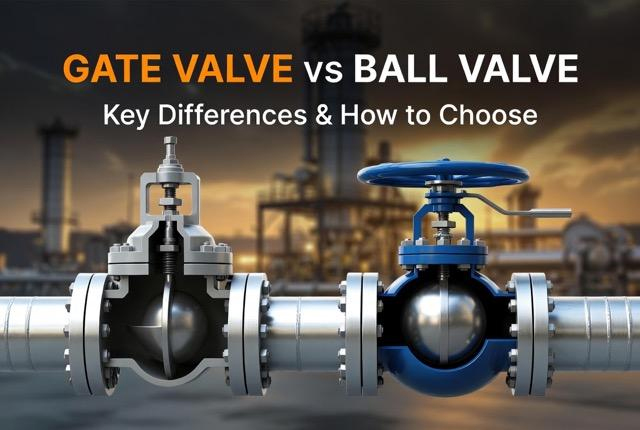
A ball valve uses a spherical closure element with a through hole. The valve opens or closes by rotating the ball 90 degrees, allowing the flow passage to align with or block the pipeline.
Key features:
Quarter-turn operation
Compact structure
Fast opening and closing
Excellent sealing performance
Suitable for frequent operation
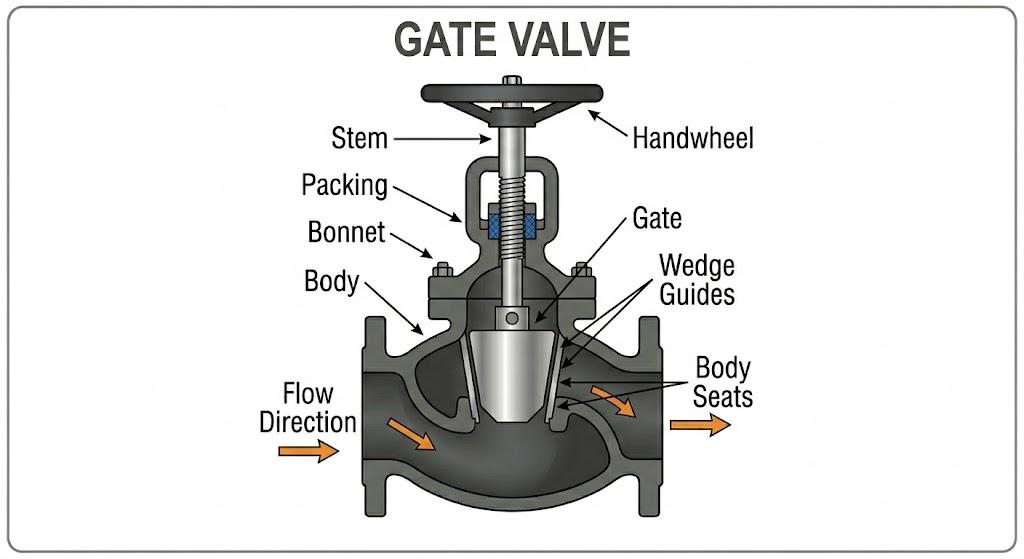
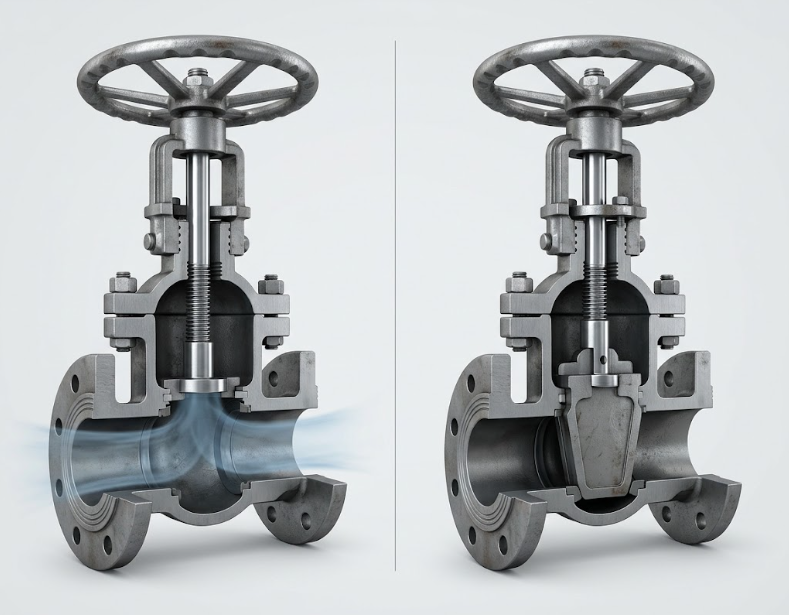
A gate valve uses a gate-shaped disc that moves vertically to open or shut off the flow. When fully open, the gate is completely removed from the flow path, resulting in minimal pressure loss.
Key features:
Linear motion design
Full bore flow passage
Low pressure drop
Suitable for isolation applications
Designed mainly for fully open or fully closed service
For a more detailed explanation of the motion, parts, isolation duty, and selection inputs, read our guide to gate valve operation and selection.
Excellent sealing performance
Quick operation with quarter-turn design
Suitable for high pressure and high temperature applications
Good flow control capability in specific designs
Reduced risk of leakage
Limitations:
Not recommended for throttling applications under standard designs
Higher cost for large sizes or special materials
Low flow resistance when fully open
Suitable for large diameter pipelines
Reliable isolation performance
Cost-effective for certain applications
Limitations:
Slower operation compared with ball valves
Not suitable for frequent operation
Not recommended for throttling service
Valve selection also involves more than operating design. Body material, pressure class, temperature, and fluid compatibility should be considered together. Learn more about cast iron valves and their typical applications.
|
Application |
Recommended Valve |
|
Frequent opening and closing |
Ball Valve |
|
Emergency shut-off service |
Ball Valve |
|
High-pressure pipeline isolation |
Ball Valve / Gate Valve |
|
Large diameter pipeline |
Gate Valve |
|
Full flow transmission |
Gate Valve |
|
Petrochemical process systems |
Ball Valve / Gate Valve |
In petrochemical and chemical processing industries, valve selection depends on factors such as pressure rating, temperature, media characteristics, operation frequency, and maintenance requirements.
High-pressure process pipelines
Gas and liquid shut-off applications
Emergency shutdown systems
Corrosive media applications requiring reliable sealing
Large diameter pipelines
Main isolation systems
Applications requiring minimal pressure loss
Long-term fully open or fully closed operation
For challenging industrial conditions, material selection and sealing technology are also critical. Options such as stainless steel, duplex stainless steel, titanium, and special alloys may be selected according to media requirements.
Both ball valves and gate valves play important roles in industrial applications. The best choice depends on the specific operating conditions, system requirements, and performance expectations.
For a broader project decision, compare the best valve for isolation service by shutoff, cycling, pressure loss, space, and operating conditions.
By understanding the differences in design, advantages, and application scenarios, engineers can select the most reliable valve solution to improve system safety, efficiency, and service life.
Kaiwei Valve provides customized valve solutions for petrochemical, chemical, energy, and industrial applications, supporting customers with reliable products and professional engineering expertise.
Kaiwei Valve — Reliable Valve Solutions for Global Industries.
More News
Oct.01, 2026
Sep.30, 2026
Sep.25, 2026


