Sep.10, 2026
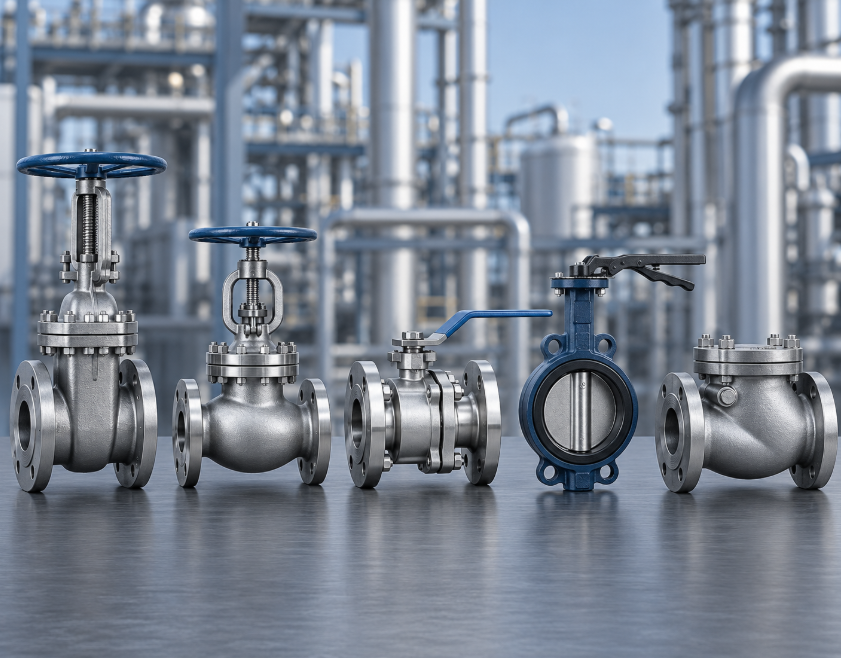
The main industrial valve types are gate, globe, ball, butterfly, and check valves. Gate and ball valves commonly serve isolation duties; globe and characterized control valves regulate flow; butterfly valves provide compact rotary control; and check valves prevent reverse flow. Final selection depends on service conditions, not the category name alone.
A valve changes flow by moving an element into, away from, or across the flow path. The element may be a gate, plug, ball, disc, or a check member driven by the process fluid. The TLV manual-valve overview provides a useful construction-based explanation of the major manual designs.
| Valve type | Basic motion | Typical starting function | Main selection caution |
|---|---|---|---|
| Gate | A gate rises out of or lowers into the flow path | Full-open/full-closed isolation | Partial opening can expose the gate and seating surfaces to damaging flow |
| Globe | A plug moves toward or away from a seat | Throttling or on-off service | The changing flow path usually creates more pressure loss than a straight-through isolation valve |
| Ball | A bored ball rotates one quarter-turn | Fast isolation | A conventional soft-seated design should not be assumed suitable for sustained throttling |
| Butterfly | A disc rotates in the flow path | Compact isolation or modulation | Disc position, seat design, offset, velocity, torque, and bidirectional pressure must be checked |
| Check | Process flow opens a closure member; reverse flow closes it | Backflow prevention | Confirm the selected model’s structure, installation orientation, flow direction/velocity, and transient operating conditions |
A gate valve provides a relatively unobstructed passage when fully open. That makes it a common starting point for isolation where the valve normally remains fully open or fully closed. It is not automatically the best choice when frequent cycling, rapid operation, small installation space, or controlled throttling is required.
A globe valve changes the flow area as its plug moves relative to the seat. This controllable relationship makes the design a frequent candidate for throttling. The trade-off is a more tortuous flow path and therefore potentially higher pressure loss. A control application still requires sizing, trim selection, actuator sizing, rangeability, noise, cavitation, and shutoff analysis.
A ball valve turns between open and closed positions through 90 degrees. Full-bore designs can provide a flow opening close to the connected pipe bore, while reduced-bore designs intentionally use a smaller opening. Seat design, ball support, cavity pressure behavior, operating torque, and service temperature all affect selection. Explore the live KAIWEI ball valve family as a starting catalog, then request model-specific data.
Butterfly valves place a rotating disc in the line and can offer a short face-to-face envelope. Concentric, double-offset, and triple-offset designs should not be treated as interchangeable. The intended duty, seat construction, pressure direction, flange compatibility, shaft orientation, available actuator torque, and allowable velocity need review. KAIWEI lists current configurations on its butterfly valve page.
A check valve is self-acting: forward differential pressure opens it, and reducing or reversing flow causes closure. KAIWEI’s catalog materials cover general and pressure-seal check-valve series and mention rapid-closing, bypass, and damping-cylinder design options, but provide no closing-time or water-hammer test data. Model-specific structure, orientation, direction, velocity, transient response, and reverse-leakage requirements therefore need engineering verification.
“Which valve is best?” is incomplete without a defined duty. Use the following sequence:
Material selection is another important factor when evaluating an industrial valve. For example, a cast iron valve may be appropriate for some utility services, while demanding applications may require steel or alloy materials.
Standards define scopes and shared requirements; they do not choose the valve for the engineer. ASME B16.34 covers subjects such as pressure-temperature ratings, materials, dimensions, examination, testing, tolerances, and marking for specified new valve construction. Product-specific standards may add design and test requirements.
A standard reference on a catalog page is not proof that every model carries a certification or suits every application. The purchase specification should identify the required edition and any project additions, while the supplier should return a model-specific compliance statement and exceptions list.
KAIWEI’s live industrial valve catalog organizes current product families for initial review. For a technical review or quotation, send the fluid and concentration, design and operating pressure/temperature, required size and class, body/trim/seat materials, end connection, standard and test requirements, actuation and controls, quantity, and document list through the contact page.
That information lets the team compare an actual product family and configuration instead of recommending a valve from the service label alone.
More News
Oct.01, 2026
Sep.30, 2026
Sep.25, 2026


