Sep.16, 2026
An on-off valve is selected primarily to start, stop, or isolate flow by moving between open and closed positions. A control valve modulates at intermediate positions to regulate a process variable such as flow, pressure, level, or temperature. The duties require different sizing data, valve characteristics, actuators, accessories, and performance checks.
When reviewing industrial valve products, define the required function before comparing body styles or actuator options.
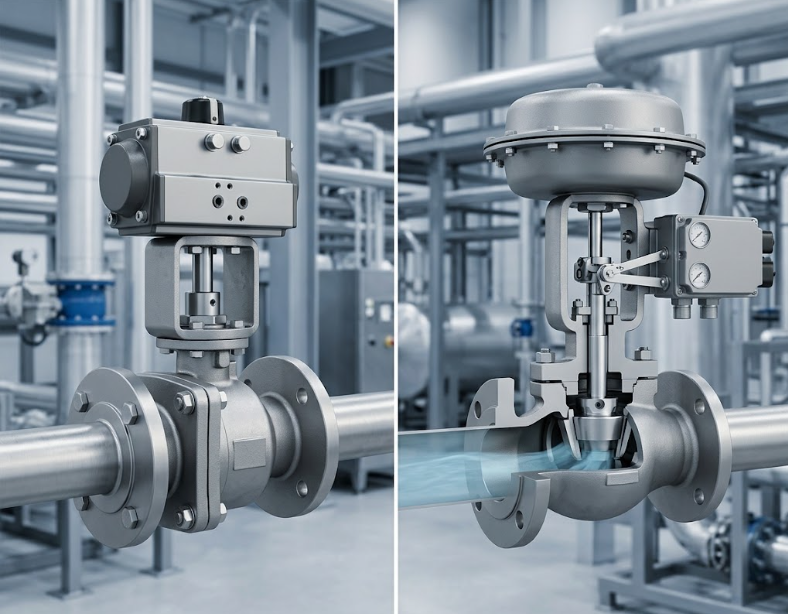
An on-off valve normally receives a discrete command and travels to an open or closed position. Typical duties include equipment isolation, batch transfer, utility switching, emergency shutdown, and routing flow between process sections.
Selection focuses on pressure-temperature rating, material compatibility, required leakage test, differential pressure at opening and closing, open-valve pressure loss, cycling frequency, stroke time, torque or thrust, fail position, and maintenance access. Ball, gate, plug, and butterfly designs may be considered depending on the service, but the family name does not guarantee a particular shutoff class or application suitability.
Quarter-turn ball and butterfly valves can provide fast compact operation. Multi-turn gate valves can provide an unobstructed passage when fully open. Each design still needs a model-specific review of seats, bore, direction, pressure, temperature, solids, and actuation.
For a closer comparison of two common isolation designs, see our ball valve vs gate valve guide.
A control valve receives a varying signal from a controller or control system and changes its opening to influence a process variable. The final control element typically combines the valve body and trim with an actuator and, where required, a positioner, instrument air set, solenoid, limit devices, or feedback instruments.
The valve is sized so that its capacity and characteristic support stable operation at minimum, normal, and maximum flow. Available pressure drop, valve authority, rangeability, noise, velocity, cavitation, flashing, gas expansion, actuator force, travel, and dynamic response may need evaluation.
Globe-style control valves are widely used because plug, seat, and cage arrangements can provide defined throttling behavior. Characterized ball or butterfly valves may also modulate when designed and sized for the duty. KAIWEI’s control valve page provides a category-level starting point; model-specific performance data are still required.
| Selection factor | On-off valve | Control valve |
|---|---|---|
| Primary objective | Open, close, or isolate | Continuously regulate a process variable |
| Normal position | Mostly fully open or fully closed | Frequently at intermediate travel |
| Typical command | Discrete open/close | Modulating signal |
| Hydraulic review | Open-position loss and shutoff cases | Cv, travel, installed characteristic, all flow cases |
| Actuator focus | End-position torque/thrust and stroke time | Positioning resolution, dynamic response, full force profile |
| Shutoff | Defined by seat design and test requirement | Must be specified separately from control performance |
| Failure behavior | Required safe open, closed, or retained position | Process-defined fail action and response |
This comparison is functional rather than absolute. One valve may be automated for on-off use, while another version of the same broad family may use specialized trim and controls for modulation.
Holding a standard isolation valve partly open can expose its closure element and seats to high velocity, vibration, erosion, or uneven loading. A conventional gate valve, for example, generally is not chosen for sustained regulation. The TLV manual-valve guide distinguishes general functions of common manual valve types, but the actual operating limits still come from the specific design.
Similarly, a control valve that regulates well is not automatically an acceptable block valve. Leakage class, test medium, test pressure, direction, temperature, cycling history, and required isolation arrangement must be stated. If a process needs both fine control and verified isolation, it may require separate valves rather than forcing one component to perform both duties.
An on-off valve often is checked for full-open pressure loss, velocity, bore requirements, closing differential pressure, and actuator torque or thrust. Pigging, line cleaning, solids passage, surge, fire case, and emergency stroke time can influence the choice.
A control valve requires a calculated flow coefficient for multiple operating cases and a review of expected travel. The valve should have sufficient capacity without being so large that normal control occurs very close to the seat. The guide to which valve is best for throttling flow explains why body style alone does not determine control performance.
On-off packages may use manual operators, pneumatic or electric actuators, solenoids, and open/closed indication. Control packages commonly add a positioner and a continuous command signal, but the exact architecture depends on plant utilities, safety requirements, hazardous-area classification, diagnostics, speed, and control-system interface.
For both duties, size the actuator for the complete pressure and friction case. State fail-open, fail-closed, fail-in-place, or other required behavior. Do not infer a safety integrity level, emergency-shutdown qualification, or hazardous-area approval merely from the presence of an actuator or positioner.
Provide the valve function; fluid, composition, phase, solids, and corrosiveness; minimum, normal, and maximum flow; upstream and downstream pressure; design and operating temperatures; line size and schedule; required coefficient or allowable pressure loss; leakage test; cycling frequency; flow direction; fail action; stroke time; utilities; signal; hazardous-area requirements; materials; end connections; and applicable standards.
ASME B16.34 addresses ratings and construction topics for valves within its scope, but it does not replace functional sizing, control-loop design, or a project-specific shutoff definition.
Before ordering, ask your supplier to confirm whether the proposed assembly is for on-off or modulating duty, the model and trim, rated Cv, expected travel, shutoff basis, pressure-temperature rating, body and internal materials, actuator sizing, accessories, fail action, standards, certificates, assumptions, and exceptions.
Need help specifying an on-off or control valve? Share your fluid, flow range, pressure, temperature, and shutoff requirements with KAIWEI VALVE to discuss valve selection and request a project-specific quotation.
More News
Oct.01, 2026

Sep.30, 2026
Sep.25, 2026


