News
Sep.25, 2026
A gate valve is a linear-motion valve that isolates flow by raising a gate out of the passage or lowering it onto the seats. It normally works best fully open or fully closed: the open position provides a comparatively unobstructed flow path, while sustained partial opening can damage the gate or seating surfaces.
For projects requiring this type of isolation, KAIWEI VALVE’s gate valve range includes bolted-bonnet and pressure-sealed wedge designs. The appropriate configuration still depends on the medium, pressure, temperature, installation, and required shutoff performance.
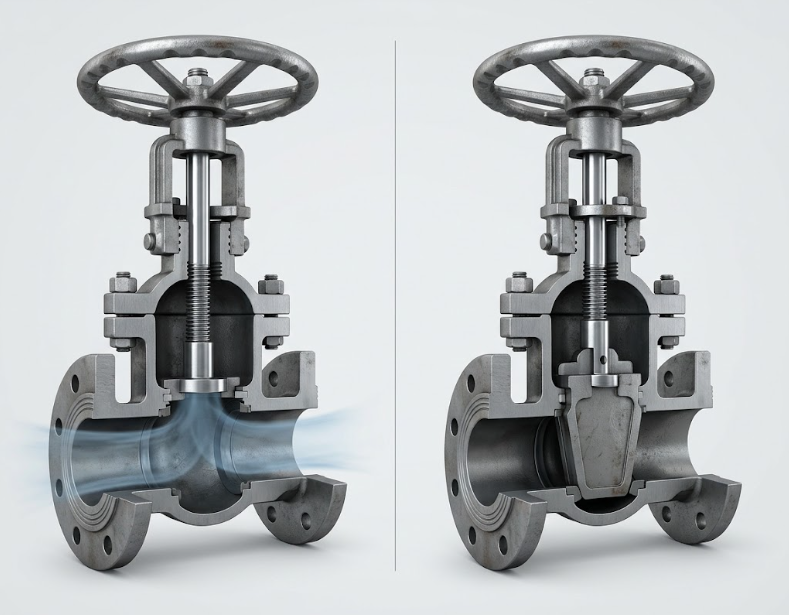
The closure element moves perpendicular to the pipeline flow. Turning a handwheel drives the stem; depending on the design, the stem rises with the gate or rotates while the gate travels. When the gate is lifted clear of the bore, fluid passes through. When the gate is lowered, its sealing surfaces contact the body seats and separate the upstream and downstream sides.
Gate forms include solid, flexible, and split designs. Their operating boundary is important: gate valves are generally not used to regulate flow because a partly open closure element can be damaged.
To compare this linear mechanism with quarter-turn operation, see our ball valve vs gate valve comparison, including differences in operating speed and cycling considerations.
| Part | Function | Buyer’s check |
|---|---|---|
| Body | Contains pressure and connects to the piping | Material specification, casting/forging route, corrosion allowance, end connection |
| Gate and seats | Establish or remove the flow barrier | Wedge/parallel design, seat materials, hardfacing, shutoff criterion |
| Stem | Transfers operating force to the gate | Rising/non-rising arrangement, material, thread protection |
| Bonnet joint | Provides access while maintaining the pressure boundary | Bolted, welded, or pressure-seal design; gasket and inspection needs |
| Packing system | Limits leakage around a moving stem | Material, temperature, emissions requirement, adjustment method |
| Operator | Supplies travel and seating force | Handwheel, gearbox, electric/pneumatic/hydraulic actuator, torque and controls |
In the fully open position, many gate-valve designs move the gate away from the main flow path. This can reduce obstruction compared with a throttling valve whose plug and internal turns remain in the flow. That makes a gate valve a logical candidate where the process needs infrequent, full-bore isolation and can accept multi-turn operation.
“Suitable for isolation” does not prove a defined leakage rate or make the design best for every line. Required shutoff depends on the applicable standard, seat design, test medium and pressure, flow direction, temperature, wear, solids, and maintenance condition. If the process demands rapid quarter-turn action, frequent cycling, piggability, controlled modulation, or a very small envelope, another valve type may be a better starting point.
When the gate is partially open, high-velocity flow can be concentrated around exposed edges and seats. Vibration, erosion, wire drawing, and unstable forces may follow, depending on the fluid and pressure drop. The handwheel position also does not provide a universally predictable flow characteristic.
For routine modulation, start by evaluating a control-valve design sized for the required flow and pressure drop. Do not retrofit a throttling conclusion from valve size alone. The control case needs minimum, normal, and maximum flow, upstream and downstream pressures, temperature, fluid properties, rangeability, shutoff class, noise, and cavitation or flashing review.
Solid, flexible, split-wedge, and parallel arrangements respond differently to alignment, temperature changes, and seating force. The correct choice depends on the specified product standard and service. Avoid generic claims that one arrangement is always tighter or longer-lasting.
A rising stem gives a visible position indication because it moves outward as the valve opens, but it needs overhead clearance. A non-rising arrangement can fit a limited envelope, while its threads and indication require different consideration. Accessibility, environment, maintenance practice, and actuator interface should drive the choice.
Bolted-bonnet and pressure-seal constructions are not interchangeable labels for pressure class. End connections such as flanged, butt-weld, socket-weld, or threaded ends affect installation, inspection, disassembly, stress, and applicable size range. For butt-welded valves, the piping specification should also define end preparation and welding requirements.
Where the project calls for a pressure-seal bonnet, KAIWEI VALVE’s pressure-sealed wedge gate valve provides a specific product to review. Confirm its material-dependent pressure-temperature rating, end connections, operator, and test requirements against the project specification before ordering.
The public API 2024 Publication Catalog describes API 600 as covering a heavy-duty series of bolted-bonnet steel gate valves with flanged and butt-welding ends for refinery and related service. It describes API 602 as covering compact gate, globe, and check valves in smaller nominal sizes for petroleum and natural-gas applications. These scopes are different; neither title alone proves that a particular valve conforms.
ASME B16.34 covers pressure-temperature ratings, materials, dimensions, examination, testing, tolerances, and marking for specified valve construction. A purchase order should state the required standard and edition, plus project-specific testing and documentation.
Before requesting a gate valve quotation, gather the information needed to size an industrial valve. For a technical review, provide:
Choosing a gate valve for your next project? Send your medium, line size, pressure, temperature, end connection, and shutoff requirements to KAIWEI VALVE to discuss a suitable configuration and request a project-specific quotation. Ask the quotation to identify the proposed model, supporting documents, assumptions, and exceptions rather than relying only on the words “gate valve.”
More News
Oct.01, 2026

Sep.30, 2026

Sep.23, 2026


