Sep.21, 2026
Industrial valves are mechanical devices that start, stop, regulate, divert, or prevent reverse flow in piping and equipment. They work by moving a closure element—such as a gate, plug, ball, disc, or check member—relative to a seat or flow passage. The required function and service conditions determine the suitable design.
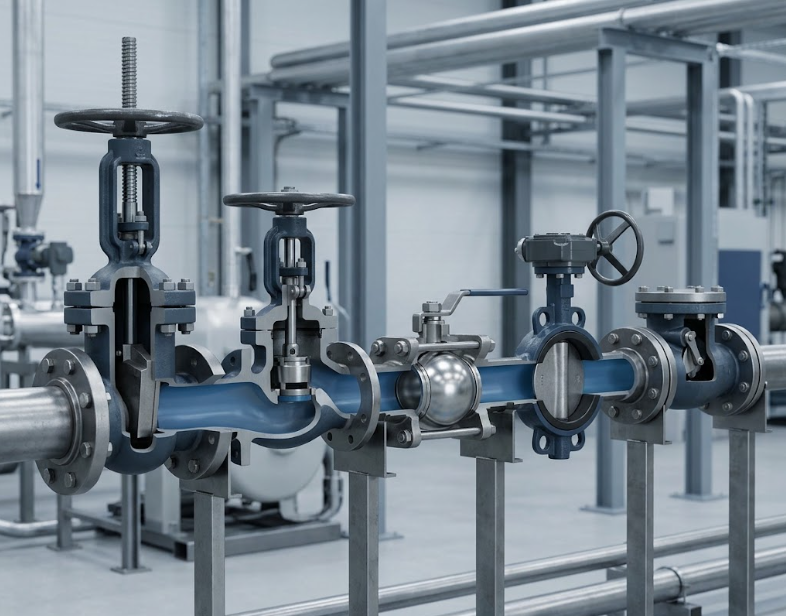
A valve changes the effective flow path between connected parts of a system. In the open position, the passage permits flow. In the closed position, the closure element contacts or approaches a seat to restrict flow. At intermediate travel, a purpose-designed valve may regulate flow, pressure, level, or temperature as part of a control loop.
The TLV manual-valve guide describes valves through the motion of the valving element. That approach is useful because two products with the same nominal size can behave very differently when one uses a straight-through rotating ball and another sends flow around a globe-style plug and seat.
Industrial valves can perform several basic tasks:
| Function | What the valve must do | Common starting families |
|---|---|---|
| Isolation | Stop flow when closed and allow the required flow when open | Ball, gate, butterfly, plug |
| Modulation | Hold intermediate positions and create a predictable change in capacity | Globe-style control, characterized rotary control |
| Backflow prevention | Open with forward differential pressure and close when flow falls or reverses | Check valve |
| Diversion or mixing | Direct flow between multiple ports | Three-way ball or control valve |
| Pressure or flow regulation | Respond to a controller or process pressure | Actuated or self-operated control valve |
These are starting categories, not automatic selections. The same family can contain different body patterns, seats, trims, pressure classes, materials, and actuator packages.
Gate and globe valves use linear travel. A gate valve raises its closure element out of the main flow path for full-open service, then lowers it to isolate the line. A globe valve moves a plug relative to a seat, changing the available flow area as travel changes. Linear motion may be produced by a handwheel, gearbox, or powered actuator.
Ball and butterfly valves normally rotate through a quarter turn. A bored ball aligns with the pipeline when open and turns across it when closed. A butterfly disc remains in the flow path and rotates between open and closed positions. Port geometry, disc design, seat loading, pressure recovery, and torque determine whether a particular rotary design is suitable for isolation or modulation.
A check valve does not normally need an external operator. Forward differential pressure moves the disc, piston, ball, or other member toward the open position. When forward flow decreases or reverses, gravity, a spring, reverse pressure, or a combination of forces closes it. Dynamic behavior depends on velocity, orientation, closing response, and the piping transient.
The body forms the primary pressure-containing shell and connects to the piping. The bonnet or body closure provides access and completes part of the pressure boundary. The closure element and seat establish the variable or closed flow area. The stem or shaft transfers motion. Packing, gaskets, seals, and bearings control leakage and friction at moving or joined interfaces. An operator or actuator supplies the required force or torque.
The word “trim” often refers to the internal functional parts exposed to process action, but the exact scope can vary by manufacturer and standard. A purchase specification should therefore list each required material rather than relying only on a generic trim number or the body material.
An industrial valve name does not define its operating envelope. Selection requires the fluid composition and phase, solids, viscosity, corrosiveness, minimum and maximum flow, upstream and downstream pressure, operating and design temperature, allowable pressure drop, shutoff criterion, cycling frequency, installation orientation, and maintenance constraints.
Pressure class also needs material and temperature. ASME B16.34 addresses pressure-temperature ratings, materials, dimensions, examination, testing, tolerances, and marking for specified valve construction. It does not choose the valve function or prove that every catalog model is suitable for every service.
KAIWEI’s live industrial valve product directory provides a starting point for reviewing ball, butterfly, globe, check, gate, and control-valve families. Buyers should then compare the relevant family page with the project data sheet rather than treating a category page as a model-level approval.
For a technical review, send the fluid, flow cases, inlet and outlet pressures, temperature envelope, line size and schedule, required function, materials, end connection, pressure class, actuation, fail action, standards, tests, certificates, and quantity through the contact page. Ask the returned offer to state the selected model, assumptions, exceptions, and document scope.
More News
Oct.01, 2026
Sep.30, 2026
Sep.25, 2026


