Nov.25, 2026
Maintain an industrial gate valve through a documented, condition-based program: identify the valve and its service, monitor changes, prepare safe isolation, perform only authorized model-specific work, and verify the assembly before returning it to service. There is no universal interval, grease or tightening torque that applies to every industrial gate valve.
The maintenance plan should reflect the valve's isolation duty. Review when a gate valve is appropriate if operators routinely leave it partly open to control flow. Maintenance cannot reliably compensate for a design used outside its intended task.
Record the tag, manufacturer, model, serial number where available, size, class, end connections, body and trim materials, bonnet type and operator. Retain the drawing, datasheet, applicable installation and maintenance manual, spare-parts list and previous inspection results.
Also document the medium, pressure and temperature envelope, cycle frequency, expected shutoff performance and consequences of isolation failure. These details help distinguish a low-consequence utility valve from a valve serving a critical hazardous process.
The main parts and operation of a gate valve provide a useful starting point, but a general diagram is not enough to select repair parts or a servicing method. Similar-looking valves can use different stem arrangements, seats, packing and bonnet joints.
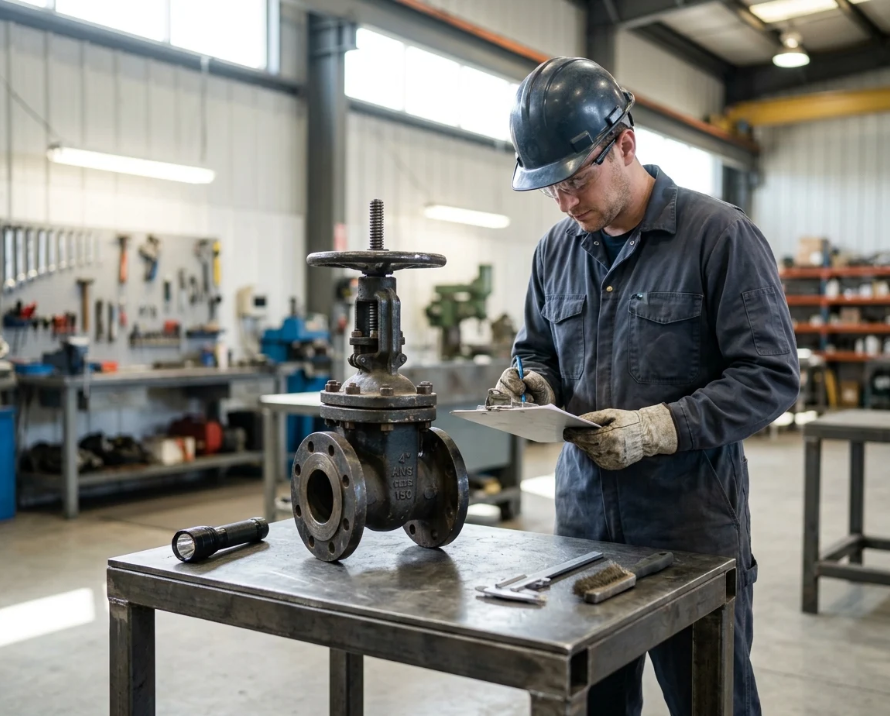
Routine condition checks may include observing visible leakage, corrosion, damaged protection, unusual vibration or changes in operating behavior from a safe location. Whether a valve may be operated for inspection is a site decision based on process and isolation requirements, not a default instruction to exercise every valve.
Intrusive work requires a different level of preparation. Follow the approved site procedures to control process pressure, trapped fluid, temperature, actuator energy and other hazards. Qualified personnel must verify the required safe state and address any possibility of pressure or energy returning.
Do not infer safe isolation from the handwheel position or a single gauge. Do not loosen packing, bonnet or flange components as a trial adjustment on a live valve. Keep disassembly and repair instructions within the approved work pack and manufacturer manual.
| Stage | What to establish | Record to keep |
| Asset baseline | Identity, construction and service requirements | Tag record, datasheet and applicable manual |
| Condition review | Leakage, corrosion, operation and changes | Dated observations and operating history |
| Work preparation | Safe isolation, scope, people and parts | Approved work pack and isolation verification |
| Authorized servicing | Model-specific limits and approved methods | Inspection findings, parts and work performed |
| Return to service | Accepted tests and operational readiness | Test results, release approval and next review |
The value of this sequence is traceability. Each stage should have a responsible person, required evidence and a release decision. A completed checklist without recorded findings is a weak basis for deciding that a valve is fit for service.
Differentiate leakage around the stem, leakage at body or bonnet joints and leakage past the closed gate. Escalate evidence of pressure-boundary damage rather than treating it as routine packing wear. Compare observations with the common industrial valve failure patterns, without diagnosing the cause from one symptom alone.
Look for recorded changes in travel, operating force, actuator alarms or limit indications. A rising operating force may justify investigation, but it does not identify a universal lubrication or adjustment solution. Confirm the permitted operating method and limits for the particular valve and operator.
Check the condition of protective coatings and exposed components as allowed by the site inspection procedure. Report changes in the process medium, cleaning regime, thermal cycling, vibration or support loads. A valve originally selected for one envelope may need engineering review after the process changes.
Review industrial valve materials when corrosion or chemical compatibility is a concern. An inspection plan should cover the actual materials and exposure, not assume that a stainless body makes the complete assembly immune to degradation.
Before the shutdown, confirm the repair scope, qualified personnel, tools, access, lifting needs where applicable and approved replacement parts. Obtain the manufacturer's instructions for packing, gaskets, stem or seat work, lubrication and assembly. Do not transfer a torque value or lubricant from a different valve size or design.
Where inspection reveals more damage than expected, stop and obtain an engineering decision rather than expanding the repair informally. Record whether the findings support repair, replacement or a change to the valve specification.
For equipment specified as an API 600 gate valve, retain its model-specific documents as well as the project standard references. The standard name is not a substitute for an installation and maintenance manual.
The work pack should define the inspection, functional checks and tests required after the particular repair. Specify approved test conditions and acceptance criteria; do not treat a casual field leak check as equivalent to every factory test.
Document installed parts, material identification, work performed, findings, test results, operator settings and authorization to return to service. Update the asset history and identify any limitations or follow-up checks. The site's controlled startup procedure should govern recommissioning.
Set the interval using the manufacturer instructions, service severity, failure consequence, operating history and applicable site requirements. A fixed generic calendar is not suitable for every installation.
No universal instruction applies. Lubrication points, materials and intervals depend on construction and service; use the approved manual and lubricant specification.
No. Cycling is not proof of seat condition, pressure-boundary integrity or safe isolation, and should only be performed when the process and procedure permit it.
Replacement may be appropriate when condition, damage, missing documentation or unsuitable duty makes a qualified repair unacceptable. Record the decision and its technical basis.
Provide KAIWEI VALVE with the existing valve identity, operating conditions, maintenance findings, access constraints and required shutoff criteria. Review the available industrial gate valve range and discuss a project-specific configuration with documentation and spare-parts requirements included in the quotation.
More News
Nov.26, 2026
Nov.26, 2026
Nov.25, 2026


