Oct.29, 2026
Valve material selection is the process of matching a valve’s body, internal components, seats, and seals to the fluid and operating conditions of a piping system. The right choice depends on the medium, pressure, temperature, corrosion risk, wear, and required valve function. A valve body that meets the pressure requirements can still fail prematurely if its trim or sealing materials are incompatible with the process fluid.
This guide explains how to select industrial valve materials, compare common material options, and avoid purchasing mistakes that can lead to leakage, corrosion, excessive wear, or unplanned maintenance.
Select valve materials according to the complete operating environment, not price or body material alone.
Evaluate the body, bonnet, trim, seat, seals, gaskets, and bolting separately.
Pressure and temperature ratings must be verified for the exact material and valve design.
Corrosion, erosion, abrasion, and chemical compatibility can affect component life differently.
Use applicable standards and manufacturer documentation to confirm the final specification.
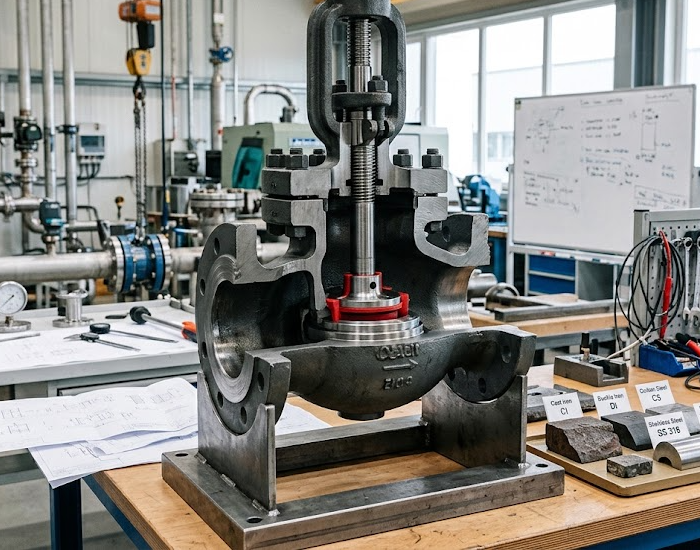
Industrial valves contain pressure, isolate equipment, and control fluid flow. Their materials influence mechanical strength, sealing performance, corrosion resistance, temperature capability, and maintenance requirements.
For example, a valve used in a water distribution system may have different material requirements from one handling concentrated chemicals, high-temperature steam, or abrasive slurry. Even within the same application, the body and sealing components may require different materials.
Choosing a material solely because it is commonly used in an industry is not enough. Engineers should also understand the valve's function, operating mechanism, and service requirements. Our guide to the main types of industrial valves explains the differences between common valve designs and their applications.
A complete material specification covers more than the valve body. The internal components and sealing elements must also be compatible with the process fluid and operating conditions.
| Component | Main Function | Key Selection Considerations |
|---|---|---|
| Body and bonnet | Contain pressure and support the valve assembly | Pressure, temperature, corrosion, applicable design standard |
| Ball, disc, gate, or plug | Open, close, or regulate flow | Fluid compatibility, erosion, wear, strength |
| Stem or shaft | Transmit operating force | Torque, bending loads, corrosion, galling |
| Seat and seat ring | Provide the primary closure interface | Leakage requirements, temperature, chemical compatibility |
| Packing and O-rings | Seal around moving or rotating components | Fluid compatibility, pressure, temperature, cycling |
| Gaskets and bolting | Seal joints and maintain joint integrity | Pressure, temperature, flange design, corrosion environment |
| Coatings and linings | Protect selected surfaces or provide a compatible wetted surface | Adhesion, chemical exposure, abrasion, temperature limits |
The exact component list depends on the valve design. For example, a ball valve uses a ball and seats, while a butterfly valve uses a disc, shaft, and seat. A control valve may also include a plug, cage, guide, or other specialized trim components.
Before finalizing a specification, buyers can review the available industrial valve product range to identify the valve type that best matches the intended function.
Cast iron is commonly considered for compatible water, drainage, HVAC, and general utility services. It offers practical casting characteristics and can be an economical option for suitable operating conditions.
However, traditional gray cast iron is relatively brittle compared with ductile iron and many steel alloys. Impact loads, pressure-temperature limits, corrosion conditions, and applicable standards must be considered before selection.
Cast iron should not be treated as a universal choice for demanding process applications. The actual material grade and valve design must be checked against the operating conditions.
Ductile iron generally provides greater toughness and impact resistance than traditional gray cast iron. It is widely used in water distribution, wastewater, irrigation, and utility piping.
The coating or lining, disc or closure material, seat, and other wetted components still require review when the fluid is corrosive or contains abrasive particles. Material selection should also account for the required pressure rating and applicable water-service standards.
Carbon steel is commonly used in industrial process systems where its strength and pressure-temperature capability meet the application requirements.
It may be suitable for certain oil, gas, steam, and general process services. However, corrosion protection, low-temperature toughness, and fluid compatibility must be evaluated for the specific grade and service conditions.
For projects in the energy sector, review the relevant KAIWEI VALVE application solutions and confirm that the proposed valve configuration meets the project's technical specification.
Stainless steel can provide improved corrosion resistance in many environments. Its performance depends on the exact grade and the fluid chemistry, temperature, chloride concentration, and other operating factors.
Stainless steel is not immune to corrosion. Pitting, crevice corrosion, and stress corrosion cracking can remain concerns in certain environments.
For chemical-processing applications, review our chemical industry valve solutions and evaluate material compatibility against the actual chemical composition, concentration, and operating temperature.
Alloy steels and specialized alloys may be required for elevated temperatures, demanding pressure conditions, or aggressive process environments. The correct choice depends on the design conditions and relevant material specifications.
A higher alloy content does not automatically make a material suitable for every application. Compatibility and mechanical properties must be verified against the intended service.
Valve trim refers to the internal components that control flow, support movement, or create sealing interfaces. Depending on the design, trim may include the stem, ball, disc, plug, wedge, seat ring, cage, and guide.
Two valves with similar body materials can behave very differently if their trim and sealing components differ.
For example, abrasive particles can wear a closure element and seat, while corrosive media can attack a stem or other wetted surfaces. High pressure drops may also increase erosion or cavitation risks in some valve applications.
When specifying trim, review:
The exact material grade and surface treatment.
Fluid composition and concentration.
Flow velocity, pressure drop, and solids content.
Operating temperature and cycling frequency.
Required shutoff performance and maintenance expectations.
Trim selection also depends on the valve's operating mechanism. For flow regulation, industrial globe valves may be considered when their pressure rating, trim design, and service limits match the application.
For quarter-turn isolation applications, industrial ball valves use a rotating ball and seat arrangement. Buyers should evaluate the ball, stem, seats, and seals together rather than specifying the body material alone.
For larger piping systems where compact construction and quarter-turn operation are priorities, industrial butterfly valves may also be considered, subject to the required flow characteristics and sealing conditions.
Seats and seals deserve separate attention because they directly influence leakage performance.
Common options include PTFE and other engineered polymers, elastomers such as EPDM, NBR, and FKM, and metal-to-metal sealing arrangements. Each has specific strengths and limitations.
| Material | General Characteristics | Selection Caution |
|---|---|---|
| PTFE | Broad chemical resistance in many applications and low friction | Verify pressure, temperature, creep, and application limits |
| EPDM | Often used for compatible water and utility services | Generally unsuitable for many petroleum oils and hydrocarbons |
| NBR | Commonly considered for oils and certain hydrocarbon services | Check temperature, chemical composition, and aging |
| FKM | Useful in many oil and chemical applications | Compatibility varies with chemical type and temperature |
| Metal seat | Can be appropriate for selected high-temperature or demanding services | Leakage class, surface finish, wear, and operating torque matter |
This table is a preliminary screening guide, not a substitute for a chemical compatibility assessment. The exact compound, concentration, temperature, pressure, and operating conditions can change the suitability of a material.
For chemical and process applications, consult the relevant chemical industry valve solutions and confirm the compatibility of every wetted component before placing an order.
Check the valve's pressure-temperature rating for the actual material and design. A nominal pressure class alone does not establish suitability at every temperature.
The pressure rating of the complete valve assembly must meet the specified design conditions. The applicable standard, material grade, end connection, and valve construction all influence the final rating.
Identify the fluid and its concentration, including relevant contaminants, chlorides, acids, alkalis, or cleaning chemicals. Review all components exposed to the medium, not just the body.
Material compatibility can change significantly with temperature and concentration. Where the fluid composition is uncertain, request a technical review rather than relying on a general-purpose material chart.
Slurry, sand, scale, and other solid particles can damage seats and trim. Consider flow velocity, particle characteristics, surface hardness, and whether specialized wear-resistant components are needed.
The appropriate solution depends on both the material and the valve design. A material that performs well under static corrosion conditions may not provide adequate resistance to high-velocity abrasive flow.
Frequent cycling can increase wear on seats, stems, and moving parts. Tight shutoff requirements, fire-safe requirements, and fugitive-emission limits may also influence the design and material specification.
Buyers should state the expected operating frequency and leakage requirements when requesting a quotation. These details help the manufacturer assess the appropriate component configuration.
Standards help define requirements for specific valve designs, materials, ratings, dimensions, testing, and documentation. They should be applied according to their scope rather than treated as interchangeable certifications.
For example, ASME B16.34 covers pressure-temperature ratings, materials, dimensions, examination, testing, and marking for specified valve constructions within its scope. API Specification 6D addresses pipeline and piping valves used in the petroleum and natural gas industries.
The applicable standard depends on the valve type, service, project specification, and jurisdiction. Buyers should confirm the required edition, testing scope, material documentation, and any additional project requirements with the engineering team and manufacturer.
Official technical references:
For additional guidance on valve configurations and application requirements, consult our industrial valve selection guide.
Choosing by price alone: A lower initial price may be outweighed by frequent replacement, downtime, or leakage.
Specifying only the body material: Seats, seals, stems, trim, gaskets, and bolting may have different compatibility requirements.
Ignoring temperature: Material performance and pressure ratings can change significantly with temperature.
Assuming stainless steel is suitable for every chemical: Corrosion depends on the exact grade and operating environment.
Using a generic material table as final approval: Reference tables support preliminary screening but do not replace model-specific technical review.
Overlooking documentation: Buyers should confirm material identification, inspection requirements, pressure testing, and traceability documentation where specified.
For additional information about material options and project customization, see the KAIWEI VALVE FAQ.
Before requesting a quotation, prepare the following information:
Valve type and intended function.
Fluid name, composition, concentration, and contaminants.
Normal and design pressure.
Normal and design temperature.
Nominal size, pressure class, and end connection.
Body, trim, seat, seal, and coating requirements, where specified.
Required design and testing standards.
Inspection, traceability, certificates, and documentation requirements.
Actuation method, operating frequency, and any special safety requirements.
If your project requires a quarter-turn valve, compare the operating conditions with the available industrial butterfly valve configurations before finalizing the specification. The selected design and materials must satisfy the complete operating envelope.
KAIWEI VALVE provides industrial valve solutions for applications that require careful consideration of valve design, materials, pressure ratings, connections, and operating conditions.
Whether your project involves industrial ball valves or other industrial valve configurations, material selection should be based on the actual service requirements rather than the valve type alone.
When requesting a quotation, share the medium, pressure, temperature, size, required standards, and any known body, trim, seat, or seal specifications. Include testing, inspection, and documentation requirements where applicable.
This information gives the technical team a clearer basis for reviewing the proposed configuration and identifying any details that still need confirmation.
Contact KAIWEI VALVE to discuss your industrial valve requirements and request a solution aligned with your project specification.
Fluid compatibility is a key consideration, but the final choice must also satisfy pressure, temperature, mechanical loads, leakage requirements, and applicable standards.
No. Trim, seats, seals, gaskets, and other wetted components must also be checked against the fluid and operating conditions.
There is no universal best material. The suitable grade depends on the chemical composition, concentration, temperature, pressure, and exposure conditions.
Soft seats can provide tight shutoff in compatible services, while metal seats may suit selected demanding conditions. The decision depends on leakage requirements, temperature, wear, fluid characteristics, and the valve design.
Provide the valve function, medium, pressure, temperature, size, connection, applicable standards, and any required body, trim, seat, and seal materials. Include testing and documentation requirements when applicable.
More News
Oct.09, 2026


