Nov.02, 2026
The main difference between a wedge gate valve and a parallel slide gate valve is how the gate contacts the seats. A wedge gate closes against inclined seating surfaces, using wedging action to develop seating load. A parallel slide design uses a gate or discs that move across parallel seat faces; depending on the design, spring force and differential pressure contribute to seating. Both are generally isolation valves, but their sealing mechanisms, operating loads, and response to temperature changes must be evaluated for the specific model.
Before comparing configurations, review how a gate valve works and define the required shutoff duty. Neither gate geometry alone proves a leakage class, pressure rating, or suitability for continuous throttling.
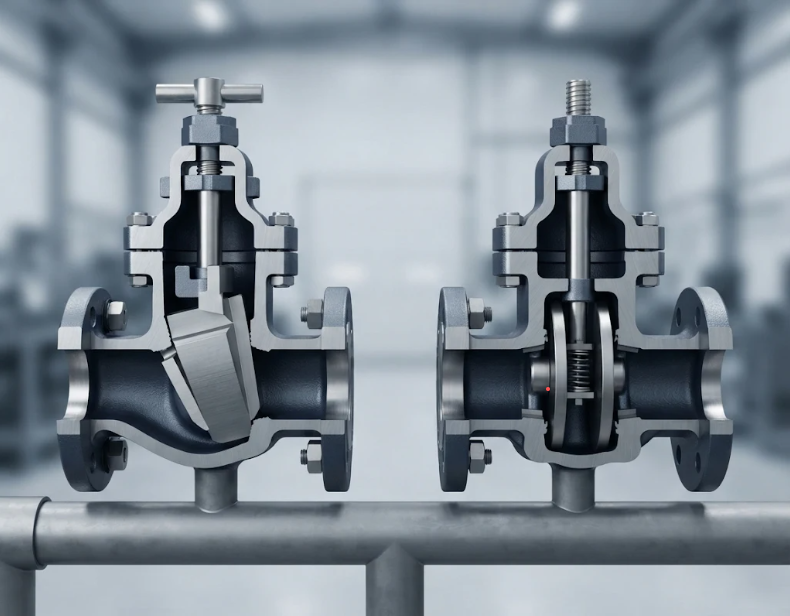
A wedge gate valve uses a closure element with angled seating faces. As the stem lowers the wedge, its faces engage corresponding seats in the body. Closing force, seat geometry, pressure, and the condition of the sealing surfaces all influence the resulting shutoff. When the gate is raised clear of the bore, many designs offer a relatively unobstructed flow path.
Wedge arrangements include solid, flexible, and split designs. These terms describe different gate constructions; they should not be treated as interchangeable without reviewing the manufacturer's data. The required closing force and reopening load also depend on pressure, temperature, friction, and the selected seat arrangement.
For a specific product example, KAIWEI VALVE lists a pressure-sealed wedge gate valve. Confirm the proposed model's materials, applicable pressure-temperature rating, end connections, operator, and test documentation for the project; the product page does not establish a rating for every wedge valve.
In a parallel slide gate valve, the seating surfaces are parallel rather than arranged as a wedge. The closure member moves across the seat faces to open or block the passage. Some double-disc designs use a spring between the discs to maintain initial contact; differential pressure can then load the downstream disc against its seat. Other designs use different disc and seating arrangements.
This distinction matters at low differential pressure: do not assume that process pressure alone will produce the required leakage performance. Ask the manufacturer how the actual model seats at the minimum and maximum specified differential pressures, in each required direction, and which tests establish the result.
Parallel slide construction does not automatically mean low-pressure service. Some manufacturers offer specific designs for steam and feedwater duty at elevated pressures and temperatures. Those examples are not evidence that every parallel slide valve—or a KAIWEI model—has the same capability.
| Comparison factor | Wedge gate valve | Parallel slide gate valve |
|---|---|---|
| Seat geometry | Inclined seating faces | Parallel seating faces |
| Closure arrangement | Solid, flexible, or split wedge, depending on design | Gate or disc arrangement sliding across the seats; construction varies |
| Seating mechanism | Stem force and wedge geometry develop seating load; pressure can also affect seating | Contact and seating load depend on the design, including possible spring assistance and differential pressure |
| Low-differential-pressure shutoff | Confirm test results and required closing load | Confirm initial seat loading and low-pressure test results for the actual model |
| Temperature changes | Assess differential expansion and potential thermal binding for the service | Parallel geometry can reduce wedging-related binding, but does not eliminate every thermal or pressure-locking concern |
| Operation | Multi-turn or powered linear motion; torque or thrust is model- and duty-specific | Multi-turn or powered linear motion; torque or thrust is model- and duty-specific |
| Typical purpose | On/off isolation | On/off isolation |
| Purchase decision | Verify wedge, seats, materials, ratings, operation, and leakage test | Verify disc arrangement, seating mechanism, materials, ratings, operation, and leakage test |
The comparison is a screening guide, not a performance ranking. When assessing a complete isolation duty, compare the gate construction alongside other isolation valve selection factors, including required shutoff, cycling, pressure loss, and space.
The wedge design develops seating load as angled surfaces engage. A parallel slide design generally does not depend on driving a wedge between inclined body seats; its contact force and pressure-assisted seating depend on the particular construction. A spring-assisted design may use springs for initial contact, but spring force alone should not be described as proof of the required shutoff.
Do not assume that one family always needs less operating torque or produces tighter shutoff. Compare the manufacturer's torque or thrust values at the specified opening and closing differential pressures, temperature, seat condition, and required actuator margin. State the leakage test standard, test medium, test pressure, flow direction, and acceptance criterion in the RFQ.
Temperature changes can affect the fit and loads between a wedge and its seats. For example, a valve closed hot and then cooled may become difficult to reopen under some conditions. Parallel slide geometry can reduce the risk of wedge-related thermal binding, but it is not a guarantee against jamming, thermal expansion effects, trapped pressure, or operating problems.
Pressure locking is a separate concern: pressure trapped in a valve's body cavity may increase the load needed to open it. Review the specific valve design, fluid, trapped-liquid scenarios, operating sequence, cavity relief requirements, and any proposed bypass with the manufacturer and project engineer. Do not drill, vent, or modify a pressure boundary without an approved engineering design.
A wedge gate valve may be a suitable starting point when a project specifies an established wedge design for line isolation and the available model meets the required pressure-temperature rating, materials, shutoff test, and operating conditions. Check whether thermal cycling, infrequent operation, or a high opening differential pressure affects the required construction or actuator.
A parallel slide gate valve may be worth evaluating where its documented seat arrangement and operating characteristics fit the isolation duty, including selected steam or feedwater services. Confirm the manufacturer's approved pressure-temperature envelope and leakage performance at the actual differential pressures. Neither design should be chosen solely because the line contains steam, water, oil, or gas.
Both styles are normally used fully open or fully closed unless the manufacturer specifically approves another duty. For continuous flow regulation, use a valve designed and sized for throttling; learn why gate valves are normally fully open or fully closed.
Provide the following for each candidate valve:
Use the industrial valve material selection guide to prepare the body, trim, seat, and packing information before finalizing the specification.
KAIWEI VALVE's gate valve range includes wedge-type product listings that can be reviewed against project requirements. Availability of a parallel slide configuration, its specifications, and its test documentation must be confirmed separately; do not infer them from the general gate valve category.
Comparing a wedge with a parallel slide design? Share your medium, line size, operating and design pressures and temperatures, differential pressure, required shutoff, and actuation details with KAIWEI VALVE to discuss available configurations and request a project-specific quotation.
Not automatically. Confirm that the proposed replacement meets the original valve's pressure-temperature rating, dimensions, shutoff test, materials, operation, and project requirements. Check any changes in cavity-pressure behavior and actuator loads with the engineer and manufacturer.
No. Some parallel slide designs are offered for elevated-pressure and high-temperature applications. Suitability and required leakage performance must be established for the specific model and operating envelope.
No. Shutoff depends on the actual seat design, differential pressure, test conditions, acceptance criteria, and condition of the valve. Compare documented results rather than assuming a universal ranking.
Conventional gate valves are generally selected for fully open or fully closed isolation. Sustained partial opening can damage seating surfaces or cause unstable flow. Use a design explicitly approved and sized for regulation when throttling is required.
Ask for the exact gate and seat arrangement, model-specific ratings, required operating loads, low- and high-differential-pressure leakage tests, applicable standards, materials, cavity-pressure treatment, drawings, and documented exceptions.
More News
Nov.16, 2026
Nov.17, 2026
Nov.17, 2026


