Oct.05, 2026
When a Gate Valve is left partly open to control flow, the narrow passage can force fluid through at high velocity while the valve’s gate and seats absorb turbulence, pressure drop, and vibration. The damage may start as small-scale erosion or wire drawing, then develop into seat leakage, unreliable isolation, and an unplanned shutdown. That makes the question Why Must Gate Valves Be Fully Open or Fully Closed? more than an operating preference: it is a maintenance, safety, and lifecycle-cost issue. At KAIWEI VALVE , we recommend treating a standard gate valve primarily as an isolation valve unless its design and manufacturer’s instructions specifically approve throttling service.
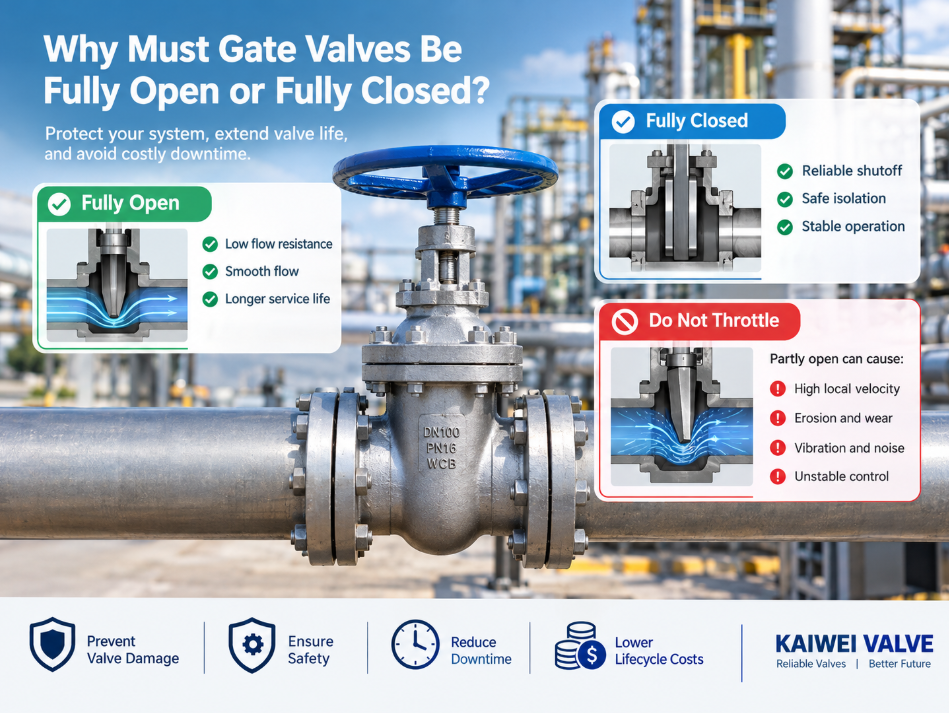
A conventional gate valve works by moving a gate, or wedge, into or out of the flow path. When fully open, the gate is mostly clear of the passage; when fully closed, it blocks the flow against the seats. In a partly open position, the gate obstructs the stream without providing the stable, purpose-designed flow-control geometry found in a control valve.
This is why the answer to Why Must Gate Valves Be Fully Open or Fully Closed? is rooted in the valve’s design. A standard gate valve is generally selected for on/off isolation, not for continuously regulating flow. There are exceptions: some specialized designs may be approved for particular throttling duties. Confirm the service conditions and manufacturer’s documentation before relying on one for that purpose.
Gate valves are valued for low flow resistance when fully open and for shutoff when fully closed. Their flow characteristic is not typically suited to precise modulation. A globe valve, a purpose-designed control valve, or another valve type selected for the control range may perform better when the process requires regular adjustment.
Partial opening can also create a misleading impression of control. The handwheel may move, but the relationship between stem travel and flow is not necessarily linear. As a result, operators may struggle to maintain a set flow rate while the valve experiences damaging local conditions. For anyone asking Why Must Gate Valves Be Fully Open or Fully Closed?, this distinction between isolation and regulation is central.
Damage risk depends on more than valve position. Differential pressure, fluid velocity, temperature, fluid chemistry, solids content, and valve construction all matter. Abrasive slurries, corrosive fluids, and high-pressure-drop service can be especially demanding. Follow the valve datasheet and operating manual; do not assume every gate valve has the same allowable duty.
For a plant or facility, the costs can extend well beyond replacing a valve. A leaking isolation point may require additional line breaks, work permits, draining, flushing, or process isolation. In critical services, the resulting downtime can affect production schedules, product quality, energy use, and worker exposure to process hazards.
Throttling can also waste hydraulic energy. Consider a clearly illustrative example: a process flow of 100 m³/h across a 2 bar pressure drop represents approximately 5.6 kW of hydraulic power dissipated at the restriction, calculated using flow rate multiplied by pressure drop. This is not a universal gate-valve performance figure or a guaranteed energy saving; actual system impact depends on the pump, process, and operating conditions. It does show why persistent pressure loss deserves an engineering review.
Imagine a facility that routinely leaves a gate valve half open to reduce flow. During an inspection, technicians find noisy operation and damaged seating surfaces. The appropriate response is not to assume a particular repair cost or failure date, but to verify the valve’s condition, record upstream and downstream pressure, check the required flow, and compare the application with the valve’s design limits. If the process needs ongoing modulation, the team can evaluate a correctly sized control valve rather than repeatedly repairing an unsuitable isolation valve.
This scenario is illustrative, not a published customer case or a claim of measured results. It reflects a practical troubleshooting sequence: establish the duty, inspect the valve, document the evidence, and select equipment suited to the task.
Applicable standards depend on valve type, material, size, pressure class, and intended service. For example, API 600 covers steel gate valves, API 602 covers compact steel gate valves, API 598 addresses valve inspection and pressure testing, and ASME B16.34 covers valve pressure-temperature ratings and related requirements. These standards do not mean that a valve is suitable for every throttling application; confirm the exact scope and applicable edition with the project specification and supplier.
For manufacturing quality, a buyer may request a documented inspection plan, material traceability, and dimensional checks using calibrated instruments with resolution appropriate to the drawing—such as 0.01 mm where the specified tolerance requires it. A stated 100% inspection or pressure-test commitment should be defined in the inspection and test plan, with records identifying the tested valves and acceptance criteria.
Ignoring the question Why Must Gate Valves Be Fully Open or Fully Closed? can turn a simple operating shortcut into a recurring reliability problem. Potential consequences include:
Risks can change as a business changes. A line that once carried clean water may later handle a hotter, more corrosive, or solids-laden fluid; a process may also move to a higher flow rate or pressure differential. Reassess valve suitability whenever the service changes instead of assuming an existing installation remains appropriate.
Follow the manufacturer’s instructions and site operating procedure. A brief position during a specific procedure is not the same as using a standard gate valve for continuous flow control. If partial opening is part of normal operation, have the application reviewed for velocity, pressure drop, vibration, and valve suitability.
No. Specialized designs and particular operating conditions may allow throttling when the manufacturer explicitly approves it. Do not generalize that exception to a conventional isolation gate valve; check the datasheet and obtain application-specific guidance.
The right choice depends on flow range, fluid properties, pressure drop, temperature, and control requirements. A control valve or other engineered flow-control device may be more suitable. Have the selection sized and reviewed for the actual process rather than choosing by pipe size alone.
Why Must Gate Valves Be Fully Open or Fully Closed? Because standard gate-valve geometry is generally intended for isolation, and sustained partial opening can expose the gate and seats to damaging flow conditions, unstable control, and avoidable lifecycle costs. Confirm the valve’s design limits, inspect its condition, and reassess it when process requirements change.
At KAIWEI VALVE , we encourage buyers and operators to share the full service conditions—not just the nominal size—when evaluating a Gate Valve. Review the datasheet, applicable standards, inspection records, and operating procedure before installation or continued use. If your process requires frequent flow regulation, take action now: ask a qualified valve specialist to assess the duty and recommend equipment designed for it.
More News
Oct.08, 2026
Oct.01, 2026

Sep.30, 2026


