News
Nov.26, 2026
The main ball valve classifications describe ball support, body construction, bore, flow path and seat system. Floating and trunnion mounted describe how the ball is supported; two-piece, three-piece and top-entry describe construction or access; full and reduced port describe the passage. These are separate categories, so one valve can belong to several at the same time.
Use the industrial ball valve range to identify relevant configurations, then compare the actual model data. A long list of type names is less useful than a specification explaining what the valve must do.
| Classification | Common descriptions | What the buyer must confirm |
| Ball support | Floating; trunnion mounted | Seat design, pressure loads and operating data |
| Body construction and access | One-piece; split-body; three-piece; top-entry; fully welded | Joint design and actual maintenance method |
| Bore | Full port; reduced port | Minimum bore and flow-capacity data |
| Flow path | Two-way; three-way; multiport | Approved port diagram for every position |
| Seat system | Soft-seated; metal-seated | Service compatibility and leakage criteria |
| Service and operation | Cryogenic configuration; manual or actuated | Model-specific qualification and operating limits |
For example, trunnion mounted, reduced port and metal seated can describe different features of the same valve. Conversely, the words three-piece do not tell you whether the valve has a particular bore, pressure rating or seat material.
If you need the basic mechanism first, see what a ball valve is and how it works. This guide focuses on classification and specification rather than repeating the complete quarter-turn operating explanation.
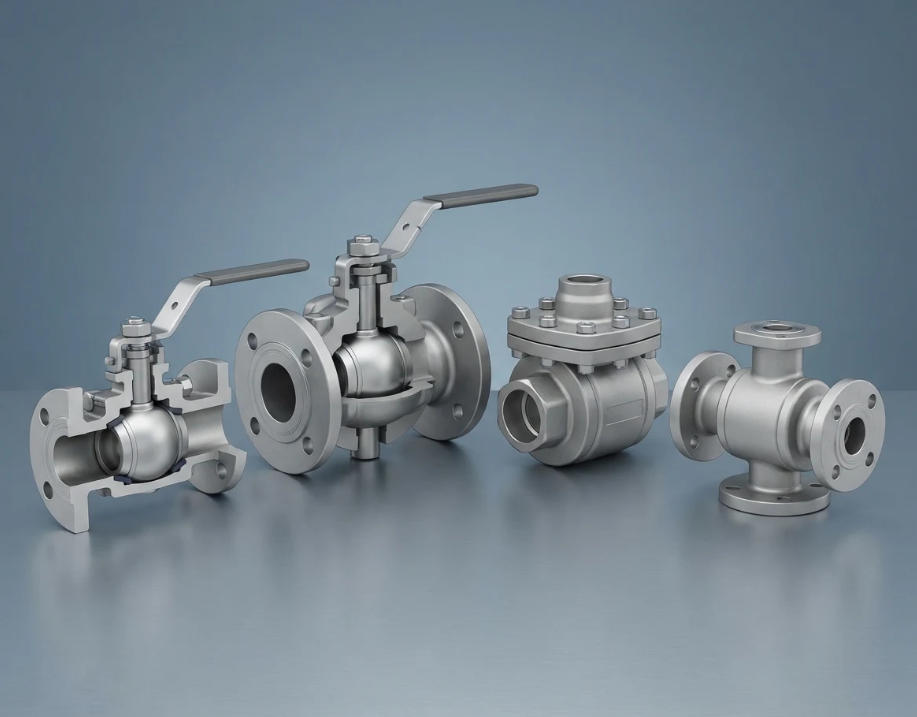
In a floating design, the ball can move slightly under differential pressure and interact with the seat system. A trunnion design mechanically supports the ball, with sealing behavior determined by its particular seat arrangement. Selection requires the actual size, pressure-temperature envelope, medium, seat design and operating data.
Do not impose a universal diameter or class boundary between the designs. Nor should trunnion support alone be used to promise a certain torque, isolation function or leakage result. The existing floating versus trunnion ball valve comparison examines the support choice in more detail.
Body descriptions may indicate how a valve is assembled or how its internals can be reached. A one-piece body, split-body assembly, three-piece construction, top-entry design and fully welded body do not offer the same access route. Terminology also needs to be checked against the manufacturer's drawing.
A three-piece design may provide a removable center section, while a top-entry design provides access from above. Whether servicing can occur with the valve installed depends on its construction, clearances and approved procedure. In-line access never means work can take place while pressure or other hazardous energy remains uncontrolled.
A fully welded body should not be assumed to permit the same body access as a bolted construction. Specify the expected maintenance strategy and ask the supplier to confirm the applicable method rather than selecting from a label alone.
Port descriptions concern the flow passage, not the ball-support method or material. Full port generally indicates a relatively large bore compared with the connection, while reduced port has a smaller passage. The actual minimum bore and applicable specification still matter.
Read the full port versus reduced port comparison when pressure loss or passage clearance is important. Full port is not an unconditional guarantee of pig compatibility, and reduced port does not automatically make a valve unsuitable for industrial isolation.
Evaluate flow capacity using the selected model's data and the operating conditions. The relationship between valve size and pressure drop helps keep connection size, bore and hydraulic performance separate.
A two-way valve commonly provides an inlet-to-outlet path for isolation. Three-way and other multiport designs can divert or connect flow paths according to the port geometry and operating position. An L-port or T-port description must be supported by the proposed port diagram.
Specify which connections may communicate at each position, which must be isolated, the allowed operating sequence and the required shutoff. Do not assume every three-way valve can safely perform any mixing or changeover duty, or that handle position proves a particular internal flow path.
Soft-seated and metal-seated describe the sealing system, but each category contains different materials and designs. Review the medium, solids, temperature, differential pressure, operating frequency and specified leakage criteria. Neither label establishes universal zero leakage or unlimited service capability.
Cryogenic or other special-service descriptions should trigger a model-specific review of materials, stem or bonnet arrangement, seals, operating limits and required tests. They are not proof that every valve of that general type is suitable for the same service.
Start with the required flow function, then record the service cases and select each relevant classification axis. A useful RFQ states the intended support arrangement, body access, bore, flow-path diagram, seat system and operator, while leaving clearly identified items for supplier review.
Provide size, pressure and temperature, medium composition, connections, operating frequency, required shutoff and documentation. The industrial ball valve selection guide connects these features to the application without treating the type name as a complete specification.
Yes. Support arrangement and body construction describe different features. Confirm the actual configuration in the manufacturer's drawing.
No. Port size does not determine ball support. Review each feature separately.
No. Its usable functions depend on port geometry, operating positions, design limits and the approved application.
No. Define the required leakage acceptance and test conditions, then verify that the selected design meets them.
Tell KAIWEI VALVE which function, flow path and maintenance arrangement the project requires, together with the fluid, size, pressure-temperature cases and sealing criteria. Request a ball valve configuration review that identifies the proposed model and documents each relevant feature rather than relying on one broad type label.
More News
Nov.26, 2026
Nov.25, 2026
Nov.25, 2026


