Sep.01, 2026
When selecting an industrial ball valve, one of the first decisions is whether a floating ball valve or trunnion mounted ball valve is better suited to the application. Both designs use a quarter-turn ball to provide reliable flow isolation, but their internal support structures differ significantly.
A floating ball valve relies on line pressure to push the ball against the downstream seat, while a trunnion mounted design uses a fixed lower and upper support system to reduce ball movement and operating torque. The right choice depends on valve size, pressure rating, media, temperature and operating conditions.
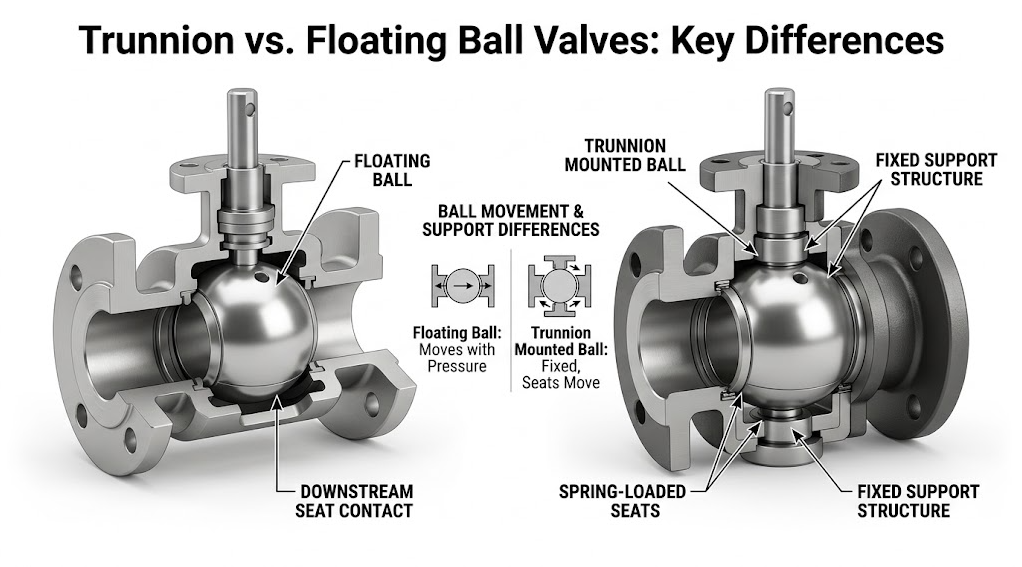
In a floating ball valve, the ball is not mechanically fixed at the bottom. Instead, the ball can move slightly under pressure.
When the valve is closed, upstream pressure pushes the ball toward the downstream seat, helping create a tight seal.
This relatively simple construction makes floating ball valves suitable for many general industrial applications where valve size and pressure requirements are moderate.
However, as valve size and pressure increase, the force acting on the ball and seats also increases. This can result in higher operating torque and greater demands on the valve actuator.
A trunnion mounted ball valve supports the ball with a fixed trunnion system. The ball does not move freely toward the downstream seat in the same way as a floating design.
This arrangement helps reduce the force required to rotate the ball, particularly in larger valves and higher-pressure applications.
Trunnion mounted ball valves are therefore widely used in applications such as oil and gas pipelines, gas transmission, petrochemical facilities and other demanding process systems.
For projects requiring larger sizes or higher pressure classes, a trunnion mounted ball valve can provide a practical combination of reliable isolation and manageable operating torque.
| Feature | Floating Ball Valve | Trunnion Mounted Ball Valve |
|---|---|---|
| Ball support | Ball is allowed to move slightly | Ball is supported by trunnions |
| Typical size | Small to medium | Medium to large |
| Pressure application | General to moderate pressure | High-pressure applications |
| Operating torque | Can increase with pressure and size | Generally lower for larger valves |
| Construction | Relatively simple | More robust support structure |
| Typical applications | General industrial service | Oil & gas, pipelines, petrochemical |
These are general selection guidelines rather than strict limits. The appropriate design depends on the actual valve specification and service conditions.
A trunnion mounted design may be considered when the project involves:
For example, Kaiwei's trunnion mounted ball valve range includes different sizes, pressure classes and configurations for demanding industrial applications.
For projects requiring a more specialized design, you can also review Kaiwei's [industrial ball valves] to compare different ball valve configurations.
A floating design may be appropriate when the application involves:
The important point is that floating ball valves should not simply be selected because they have a simpler design. Pressure, temperature, media and valve size still need to be checked against the manufacturer's technical specifications.
A practical selection process starts with five questions:
Valve size affects the forces acting on the ball and seats. Larger pipelines often require a trunnion mounted design.
Higher pressure can increase the force acting on the ball and therefore influence operating torque and seat loading.
Gas, oil, water and corrosive or abrasive media may require different body, seat and sealing materials.
High-cycle applications can place additional demands on seats, seals and operating components.
API, ASME and other applicable standards should be confirmed before selecting the final valve configuration.
There is no universal answer to whether a floating or trunnion mounted ball valve is better. The correct design depends on the combination of size, pressure, temperature, media, sealing requirements and operating conditions.
Floating ball valves can be suitable for many general industrial services, while trunnion mounted designs are commonly selected for larger and higher-pressure applications.
Before choosing a ball-support design, confirm whether a ball valve is the right industrial isolation valve for the complete duty.
For a broader comparison of available designs, explore Kaiwei's industrial ball valves and select the configuration according to your project requirements.
If the required valve family has not yet been decided, first compare gate, globe, ball, butterfly, and check valves by function and operating conditions.
Need help selecting a ball valve? Contact Kaiwei with your required size, pressure class, media and operating conditions for a suitable configuration.
More News
Oct.01, 2026
Sep.30, 2026
Sep.25, 2026


