Sep.03, 2026
Choosing an industrial ball valve is not simply a matter of selecting the correct pipe size. The valve must also match the system's pressure, temperature, media, sealing requirements, operating method and applicable standards.
For industrial buyers, the key is to start with the actual operating conditions and then select the appropriate ball valve type, material and configuration.
A ball valve is only one possible starting point, so compare the common industrial valve types before narrowing the selection to a specific ball-valve design. A ball valve is one example within the broader group of industrial flow-control valves.
The first step is to determine what will pass through the valve.
Common media include:
The medium affects the selection of body materials, seat materials, seals and other wetted components.
For corrosive or chemically aggressive media, material compatibility should be confirmed with the valve manufacturer before ordering.
Pressure and temperature are two of the most important factors in valve selection.
Before choosing a valve, confirm:
For example, a valve designed for a moderate-pressure utility system may not be appropriate for a high-pressure oil and gas pipeline.
Kaiwei offers ball valve configurations across different pressure classes and temperature requirements. The exact specification should be selected according to the project conditions.
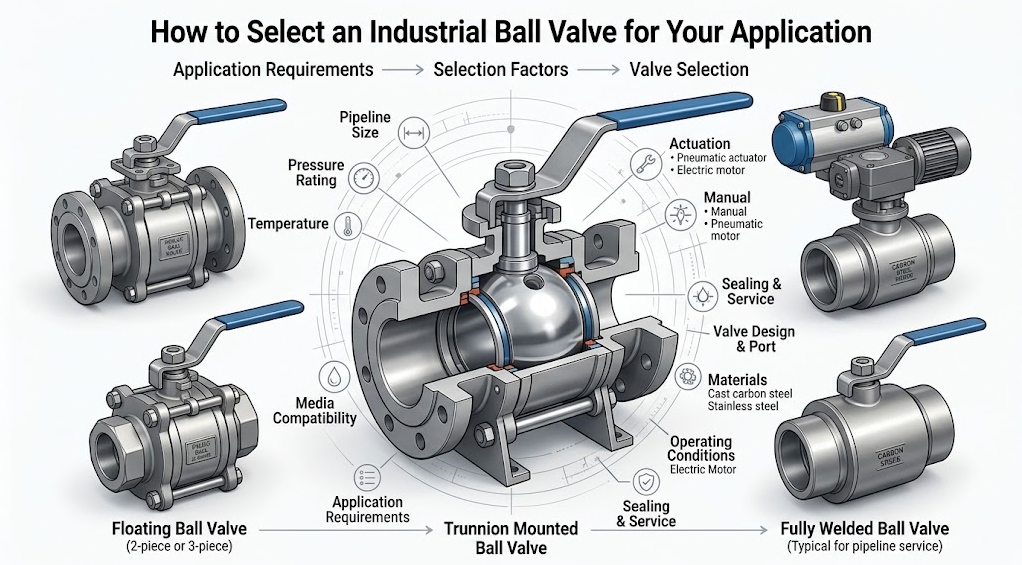
Different ball valve constructions are intended for different requirements.
A floating ball valve allows the ball to move slightly under pressure and is commonly used in smaller or general industrial applications.
A trunnion mounted ball valve uses a supported ball and is commonly applied to larger sizes and higher-pressure systems.
A fully welded ball valve is designed for pipeline applications where a welded body construction is preferred.
A top-entry ball valve allows access to internal components from the top, which can be useful when maintenance requirements are an important consideration.
A double block and bleed ball valve provides two isolation barriers with a bleed function for applications requiring enhanced isolation arrangements.
You can compare these configurations through Kaiwei's industrial ball valves range.
Port configuration also affects valve selection.
A full-port ball valve has a flow passage that is closer to the pipeline's internal diameter, which can help reduce flow restriction.
A reduced-port ball valve has a smaller flow passage and may offer a more compact or economical configuration for applications where full flow capacity is not required.
The decision should be based on flow requirements, pressure drop, pipeline design and project specifications.
Before choosing the port configuration, review how valve size affects pressure drop at the required operating flow.
Valve materials should be selected according to the medium and operating conditions.
Typical body materials may include:
Seat and sealing materials also need to be evaluated for compatibility with the process medium and temperature range.
For demanding services, material selection should be confirmed through the manufacturer's technical documentation rather than based solely on general material descriptions.
Ball valves can be operated manually or supplied with an actuator.
Depending on the project, options may include:
For larger valves or automated process systems, actuator sizing should consider the valve's operating torque and actual service conditions.
Industrial projects may require specific design, testing and dimensional standards.
Depending on the application, buyers may need to check standards such as:
Not every ball valve needs to meet every standard. The required standards should be determined by the project specification and application.
Before requesting a quotation, prepare the following information:
| Parameter | Information to Provide |
|---|---|
| Valve type | Floating / trunnion / fully welded / other |
| Size | NPS or DN |
| Pressure class | Class 150 / 300 / 600 / etc. |
| Medium | Gas / oil / water / chemical / etc. |
| Temperature | Minimum and maximum |
| Body material | Carbon steel / stainless steel / alloy |
| Connection | Flanged / welded / other |
| Port | Full / reduced |
| Operation | Manual / pneumatic / electric |
| Applicable standards | API / ASME / project-specific |
Providing these details allows the manufacturer to recommend a configuration more accurately and prepare a quotation based on the actual application.
The model-specific valve flow coefficient helps verify open-position pressure loss instead of relying on nominal size alone.
The right industrial ball valve should be selected according to the complete operating environment rather than a single parameter such as pipe size or pressure.
By checking media, pressure, temperature, size, valve design, materials, port configuration, operation and applicable standards, buyers can narrow down the appropriate configuration before placing an order.
Kaiwei provides multiple industrial ball valve configurations for oil and gas, petrochemical, chemical, power and other industrial applications.
Looking for a ball valve for a specific application? Send Kaiwei your size, pressure, medium and operating requirements for technical support and a quotation.
More News
Oct.01, 2026
Sep.30, 2026
Sep.25, 2026


