News
Sep.30, 2026
At the same flow rate, a valve with a larger effective flow area will generally produce lower velocity and less pressure drop than a more restrictive valve. However, nominal valve size alone does not predict the loss. Bore diameter, internal geometry, valve type, travel position, flow coefficient, reducers, fittings, and fluid condition all affect the result.
When comparing KAIWEI VALVE’s ball valve range, for example, confirm the actual bore and rated flow coefficient rather than choosing by connection size alone.

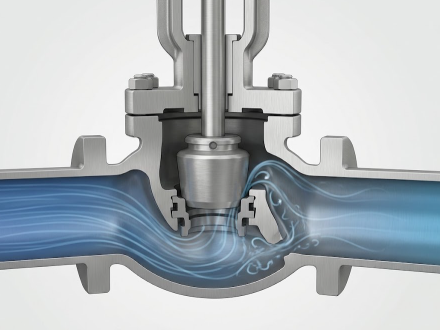
Flow accelerates when it passes through a restriction. The conversion between static pressure and velocity, plus turbulence and friction through the valve, produces a pressure difference between upstream and downstream measurement points. A larger usable passage usually reduces the restriction for a given flow, while a smaller passage usually increases it.
The important term is usable flow area, not the size stamped on the body. Two DN100 or NPS 4 valves can have different port diameters, discs, cages, seats, body passages, and flow coefficients. A full-port ball valve and a reduced-port ball valve with the same end connection therefore need not create the same loss.
Cv, the valve flow coefficient, expresses valve capacity under defined reference conditions. For an incompressible liquid in a simplified non-choked case, the relationship is commonly rearranged as:
ΔP = SG × (Q / Cv)²
Here, Q is flow in US gallons per minute, SG is liquid specific gravity relative to water, and ΔP is pressure drop in psi. The units and definition must remain consistent. If the valve’s Cv doubles while flow rate and specific gravity remain fixed, the calculated pressure drop falls to one quarter in this simplified relationship.
This equation is a screening tool, not a universal sizing method. Viscosity corrections, piping geometry, vapor pressure, flashing, cavitation, gas expansion, sonic limits, temperature, and Reynolds-number effects may need to be included. The Fisher Control Valve Handbook provides fuller sizing methods and cautions for control-valve applications.
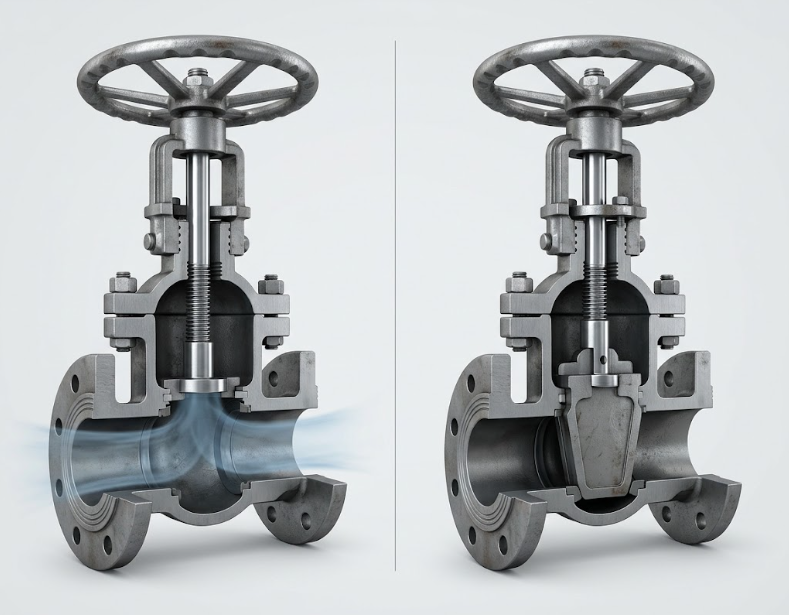
When fully open, a full-port ball valve can present a relatively straight passage. A gate valve generally withdraws the gate from the primary flow path. In a butterfly valve, the disc and shaft remain in the flow even when open. Globe and control-valve bodies deliberately redirect or restrict flow so that the closure element can regulate it.
These descriptions do not establish a universal ranking. A particular valve’s coefficient depends on its exact construction and position. Compare published model data at the required travel and flow direction rather than assigning one generic value to an entire valve family.
For disc-style options, KAIWEI VALVE’s butterfly valve range provides a category-level starting point. Confirm the specific geometry, coefficient at the intended opening, pressure-temperature rating, materials, and operating limits for the quoted model.
A line-size valve is not necessarily the lowest-cost or best-performing selection, and a smaller valve between reducers is not automatically unacceptable. The calculation should include reducer geometry, elbows, tees, strainers, meters, pipe roughness, straight-run lengths, and any equipment in the evaluated segment.
Pressure measurement location also matters. A manufacturer’s rated Cv describes the valve under specified test conventions; field readings can include additional piping losses. Define the pressure taps and system boundary before comparing a calculation with operating data.
For an isolation valve, the objective may be low open-valve loss while still meeting shutoff, torque, cycling, and maintenance requirements. Confirm the bore needed for pigging or cleaning and whether a reduced port changes system performance.
For a control valve, some pressure drop is needed for authority over the process. Selecting a large body merely to minimize loss can leave the valve operating close to its seat, where small travel changes create large flow changes and stable control may be difficult. The correct choice balances available pressure drop, required rangeability, noise, velocity, cavitation or flashing risk, actuator force, and travel across minimum, normal, and maximum cases.
Use the industrial valve sizing data checklist to organize the process and piping inputs before comparing pressure-drop calculations.
Provide the fluid and composition; liquid, gas, steam, or mixed phase; density or specific gravity; viscosity; vapor pressure; molecular weight and compressibility where applicable; minimum, normal, and maximum flow; upstream and downstream pressure; temperature; line size and schedule; allowable pressure loss; valve type; required travel; and nearby fittings.
Also state design pressure and temperature, shutoff differential pressure, leakage requirement, fail position, actuator utilities, cycling frequency, noise limit, solids, corrosion allowance, and applicable standards. ASME B16.34 addresses pressure-temperature ratings and construction topics for valves within its scope, but compliance does not replace hydraulic sizing.
Ask your supplier to identify the proposed model and size, bore, rated Cv by travel where relevant, calculation method, assumed piping geometry, predicted pressure drop, velocity checks, pressure-temperature rating, materials, actuator basis, standards, exclusions, and data that still require confirmation.
Need to select a valve within your available pressure-drop budget? Share your flow range, fluid properties, inlet and outlet pressures, temperature, pipe size, and nearby fittings with KAIWEI VALVE to discuss the bore and valve configuration and request a project-specific quotation. State whether the valve is for isolation or modulation so both hydraulic performance and operating duty can be reviewed.
More News
Oct.01, 2026
Sep.25, 2026
Sep.23, 2026


