Nov.09, 2026
Choosing between a full port and a reduced port ball valve is not just a question of valve size. The bore affects how fluid passes through the valve, how much pressure may be lost and whether pipeline inspection or cleaning equipment can pass through.
A full port ball valve generally has a bore close to the internal diameter of the connected pipe. A reduced port ball valve has a smaller flow passage than the pipe connection. Both can be suitable for isolation, but the right choice depends on the process conditions and project requirements.
This guide compares the two designs and explains what engineers and buyers should check before making a decision. For a broader overview of construction, materials and operation, see how to select an industrial ball valve.
| Selection factor | Full port ball valve | Reduced port ball valve |
|---|---|---|
| Flow passage | Bore is generally close to the pipe’s internal diameter | Bore is smaller than the pipe connection |
| Flow capacity | Generally higher for comparable designs and end sizes | Generally lower for comparable designs and end sizes |
| Pressure drop | Generally lower when fully open | Generally higher when fully open |
| Pipeline pigging | Often considered where pig passage is required; compatibility must be checked | The smaller bore may prevent passage of the intended pig |
| Size and cost | Can be larger, heavier and more costly | Can be more compact and economical |
| Typical selection priority | Minimizing flow restriction or accommodating pigging | Meeting flow requirements with an acceptable pressure drop and cost |
These are general comparisons. Actual performance depends on valve geometry, bore dimensions, flow conditions and the manufacturer’s data.
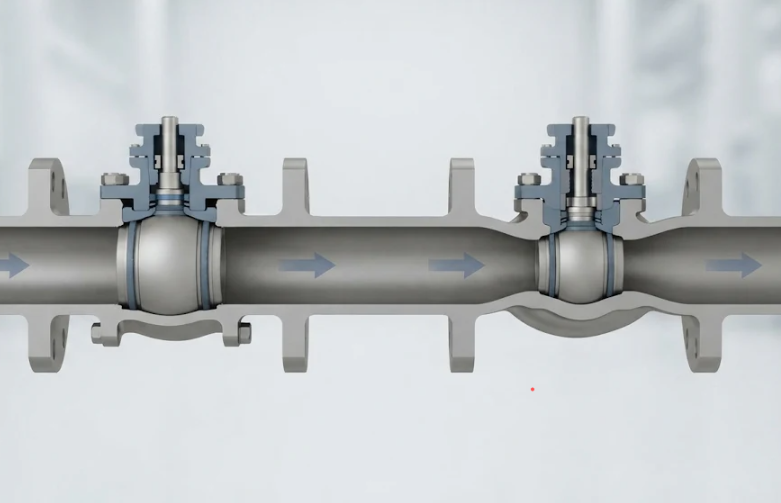
A full port ball valve, also called a full bore ball valve, has a flow opening generally close to the internal diameter of the connected pipeline. When the valve is fully open, the passage provides relatively little restriction to flow.
This configuration is often considered when:
However, “full port” does not mean that every valve opening exactly matches every pipe’s internal diameter. Pipe wall thickness, valve design and the applicable specification all matter. Ask for the actual minimum bore dimensions when clearance is important.
A reduced port ball valve, also called a reduced bore ball valve, has a flow opening smaller than its end connection. Fluid passes through a narrower section as it moves through the valve.
A reduced port design can be a practical option when the system can tolerate the additional pressure drop and does not require the full flow area of the pipe. Depending on the product, it may also offer a more compact or economical configuration.
Reduced port does not mean the valve is unsuitable for industrial service. It means the narrower flow passage must be evaluated against the actual operating requirements.
At the same flow rate and for otherwise comparable valve designs, a reduced port valve will generally cause more pressure drop than a full port valve. The narrower passage increases flow velocity through the restriction.
However, port size alone does not determine the final pressure loss. The result also depends on:
The engineering team should compare the available pressure-drop allowance with a calculation based on the selected valve’s published data. For more detail, read how valve size affects pressure drop.
Consider two ball valves with the same nominal end connection, one full port and one reduced port. If both are fully open under the same liquid flow conditions, the reduced port design will generally create a higher pressure drop.
That does not automatically make it the wrong choice. If the calculated loss remains within the project’s allowance and there is no pigging requirement, the reduced port option may still meet the specification. The final comparison should use the actual Cv or Kv values for the two proposed models.
A full port design is worth considering when the system places a high priority on a relatively unobstructed flow path.
If the system has a limited pressure-drop budget, a full port valve may help reduce the restriction across the valve when fully open. This should still be checked through a system calculation rather than assumed from the port label.
Pipelines that use cleaning or inspection pigs often require a suitable full-bore passage. However, a full port label alone does not guarantee pig passage.
Confirm the minimum through-bore dimensions, any internal obstructions, the pig’s dimensions and flexibility, and compatibility with the complete pipeline system.
Some projects define minimum bore dimensions or require a full-bore valve for operational or maintenance reasons. In these cases, compare the valve drawing and dimensions with the project specification before ordering.
A reduced port ball valve may be appropriate when full-bore passage is not required and the additional pressure drop is acceptable.
For example, it can be considered for an isolation point where:
The decision should account for both purchase price and operating impact. A lower initial valve cost may not be the most economical choice if the resulting pressure loss is unacceptable over the life of the system.
No. A full port valve offers advantages where flow restriction or pigging clearance is important, but it is not automatically the best choice for every application.
A reduced port valve can be suitable when its flow capacity and pressure drop meet the design requirements. The right comparison is not simply “larger bore versus smaller bore”; it is verified performance versus the needs of the system.
Likewise, port size does not by itself establish the valve’s pressure rating, shutoff performance, material compatibility or suitability for throttling. These must be confirmed for the specific valve model and service.
Many conventional ball valves are selected primarily for on/off isolation. Using a valve partly open for continuous throttling requires a design intended and sized for that duty.
Whether a valve is full port or reduced port does not, on its own, establish that it is suitable for control service. Flow characteristics, differential pressure, potential cavitation or noise, seat wear and actuator requirements should be reviewed with the manufacturer.
If the main requirement is shutoff rather than flow control, compare the isolation duties and leakage requirements described in which valve is best for isolation service.
Before requesting a quotation or finalizing a valve specification, prepare the following information:
For systems requiring a specific isolation and bleed arrangement, the bore decision is only one part of the selection. Review the required seat configuration and project definition separately when considering a DBB ball valve.
The terms are commonly used interchangeably to describe a valve with a bore generally close to the connected pipe’s internal diameter. For critical applications, confirm the actual minimum bore rather than relying on terminology alone.
Its smaller passage introduces more restriction than a comparable full port design. Whether that restriction matters depends on the required flow rate, allowable pressure drop and the valve’s actual flow coefficient.
It may be suitable, but full port construction alone is not proof of compatibility. The valve’s minimum bore and internal geometry must accommodate the specific pig and pipeline arrangement.
They can be less expensive than comparable full port valves, but the difference depends on size, materials, pressure class and construction. Compare quotations alongside the calculated operating impact.
No. Nominal pipe size helps establish the connection, but it does not establish the required bore, flow capacity, pressure rating or material suitability. Review the complete operating conditions and the proposed valve data sheet.
A full port ball valve is often the starting point when low flow restriction or pigging clearance is important. A reduced port ball valve can be a practical alternative when its capacity and pressure drop meet the system requirements.
For help reviewing your application, contact KAIWEI VALVE with your process medium, flow conditions, pressure and temperature, pipe details and any pigging or shutoff requirements. The appropriate valve configuration can then be discussed against the project specification.
More News
Nov.16, 2026
Nov.17, 2026
Nov.17, 2026


