Nov.17, 2026
The main types of check valves include swing, lift or piston, dual plate, tilting disc, axial-flow, and ball check valves. All are intended to limit reverse flow, but their closure elements move differently and respond differently to changing flow. The right design depends on the medium, minimum and maximum flow, pressure, temperature, installation orientation, allowable pressure loss, and system behavior when flow slows or reverses.
KAIWEI VALVE's check valve range lists swing, tilting disc, dual plate, and axial-flow designs, together with pressure-seal configurations. Each product should be reviewed against its own data sheet and the project conditions.
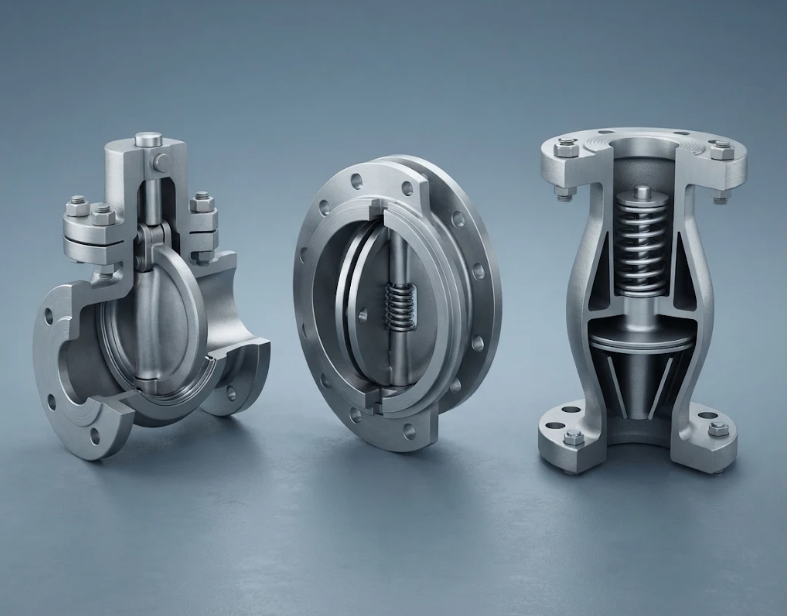
A check valve responds to the pressure and flow conditions in the line rather than to a normal open/close command. Forward differential pressure moves a disc, plate, piston, ball, or other closure member away from its seat. As forward flow decreases or reverses, gravity, a spring, reverse pressure, or a combination of these forces moves the closure member toward the seat, depending on the design.
The pressure needed to begin opening is not the same as the flow required for stable operation. If the closure member oscillates during low or fluctuating flow, wear and noise may result. For the broader context, see how industrial valves work and how self-acting motion differs from manually operated valve movement.
| Type | Closure movement | Selection points |
|---|---|---|
| Swing | A hinged disc swings away from or back toward the seat | Flow range, disc stability, orientation, shutdown conditions, and maintenance access |
| Lift or piston | A guided disc or piston moves away from and toward its seat | Body pattern, permitted orientation, fluid cleanliness, flow, and pressure loss |
| Dual plate | Two plates pivot around a central support; many designs use springs | Spring design, flange compatibility, available space, orientation, and closing response |
| Tilting disc | A disc pivots on a mounting arrangement within the flow path | Opening behavior, pressure loss, closure response, and installation requirements |
| Axial-flow | A guided closure element moves along the flow axis; some designs use a spring | Minimum flow, differential pressure, spring selection, and transient behavior |
| Ball check | A ball moves away from or toward a seat in response to flow | Ball and seat materials, orientation, fluid compatibility, and maintenance |
These descriptions are starting points. Individual valve geometry and manufacturer instructions determine actual performance and installation limits.
For a comparison with isolation and flow-control designs, review the main types of industrial valves before deciding which function the line requires.
A swing check valve uses a hinged disc that moves away from the seat under forward flow and returns toward it when conditions change. It is commonly considered for process and utility lines where the operating flow and shutdown behavior suit the selected design.
Check whether the disc remains stable at minimum normal flow and whether the piping layout provides the required installation orientation and access. A swing design should not be assumed to close at a particular speed or prevent water hammer without model- and system-specific evidence.
A lift check valve uses a guided disc or piston that moves relative to the seat as pressure changes. Body patterns and guiding arrangements differ, so the required flow direction and permitted mounting position must be taken from the exact model's instructions.
Review fluid cleanliness, potential deposits, moving-part guidance, pressure loss, and maintenance access. A piston or lift mechanism is a general valve category; confirm the manufacturer's current product offering before specifying a particular configuration.
A dual plate check valve uses two plates that pivot on a support. Many versions use springs to assist closure. The compact wafer-style arrangement used by some designs can help when the installation has limited face-to-face space, but flange dimensions, gasket interfaces, and clearance around the plates must be checked.
Spring assistance does not prove a specific closing time or eliminate surge. Ask for the allowable orientation, minimum operating flow, pressure loss, and expected closing behavior for the proposed assembly.
In a tilting disc check valve, the disc pivots within the flow path. Its movement and loading depend on the geometry of the body, pivot, and disc. When comparing a tilting disc with a conventional swing design, assess the complete operating range rather than assuming that one type always closes faster or has a lower pressure drop.
KAIWEI VALVE lists a tilting disc product family in its check valve category. Confirm the proposed model's materials, pressure-temperature rating, mounting position, and available closing-response information for the duty.
An axial-flow check valve has a guided closure element that moves generally along the flow axis. Depending on the model, a spring may assist the closing movement. Such designs can be evaluated for pump, compressor, or pipeline duties where closing response and changing flow deserve particular attention.
The required spring, opening behavior, and pressure loss are model-specific. For systems sensitive to flow reversal or surge, provide the supplier with transient information and request a system-level review; an axial-flow label or “non-slam” description alone does not prove that water hammer cannot occur.
A ball check valve uses a ball as the closure member. Forward flow moves the ball away from its seat, and changing pressure or flow conditions allow it to return. Ball, seat, guide, and spring arrangements vary by product.
A ball check valve is not the same as a quarter-turn ball valve used for manual or powered isolation. This article discusses ball check valves as a general design; a specific KAIWEI ball check valve model and its availability require separate confirmation.
Supply minimum, normal, and maximum flow—not only the design maximum. Ask the manufacturer to evaluate whether the closure member can operate stably at low flow, whether the available differential pressure is adequate, and what pressure loss to expect at each case. The guide to what causes pressure drop across a valve explains why flow conditions and internal geometry matter.
Describe pump trip, startup, normal shutdown, flow reversal, line length, and any existing surge analysis. Closing behavior is influenced by the valve and the system. Obtain model-specific response information when available, and involve a qualified engineer where transient pressure is critical. Do not select by an unverified promise of “silent” or “zero water hammer.”
Follow the manufacturer's flow arrow and approved installation positions. Horizontal or vertical installation cannot be assumed for every swing, lift, or spring-assisted design. Consider solids, viscosity, deposits, corrosion, and the effect of the fluid on the disc, spring, seat, body, and seals. Use the industrial valve material selection guide to prepare the wetted-material requirements.
State the applicable leakage test, test pressure and medium, acceptance criteria, inspection documents, face-to-face dimensions, end connections, and maintenance constraints. If personnel safety or maintenance requires positive isolation, define the required isolation arrangement separately; do not rely on a check valve alone without project approval.
Provide the medium and composition; phase and solids; minimum, normal, and maximum flow; upstream and downstream pressure; design and operating temperatures; line size and schedule; permitted pressure drop; flow direction; mounting orientation; pump or compressor operation; shutdown and reversal conditions; required materials and end connections; leakage criteria; and applicable standards and documentation.
Include line drawings, available transient or surge data, installation clearances, and maintenance expectations where relevant. The industrial valve sizing data checklist offers a broader framework, but check-valve closure and stability still require design-specific review.
Comparing check valve designs for a pump, compressor, or process line? Share your fluid, flow range, pressure, temperature, line size, installation orientation, and shutdown conditions with KAIWEI VALVE to discuss available configurations and request a project-specific quotation. Ask the quotation to identify the model, disc or plate arrangement, ratings, materials, permitted orientation, test basis, assumptions, and any missing transient data.
Swing, dual plate, lift, tilting disc, and axial-flow designs are all used in industrial systems. The appropriate choice depends on the application; there is no single type that is best for every line.
Not automatically. Reverse leakage depends on the seat design, valve condition, differential pressure, and specified test acceptance. State the required leakage criterion and obtain the applicable test documentation.
Some models permit vertical installation in a specified flow direction; others do not. Confirm the manufacturer's instructions for the exact valve, spring arrangement, and operating conditions.
A conventional swing check uses a hinged disc; a dual plate check uses two pivoting plates and may use springs. Compare actual body geometry, installation limitations, flow range, pressure loss, and closing behavior rather than assuming a universal performance ranking.
Do not assume so. A check valve is intended to limit reverse flow, while a maintenance or safety isolation arrangement has its own operating, leakage, and verification requirements. Follow the project isolation procedure.
More News
Nov.16, 2026
Nov.17, 2026
Nov.12, 2026


