Nov.26, 2026
The main difference between a two-piece and a three-piece ball valve is the body assembly and the resulting access to internal components. A typical two-piece valve has a main body and a separate body component; a typical three-piece valve has a center section between two end components. Piece count alone does not determine bore, pressure rating, material quality or leakage performance.
When comparing industrial ball valve configurations, ask for the proposed model's drawing and maintenance instructions. Names used in small process valves and large pipeline valves should not be treated as a universal construction standard.
The number normally refers to principal body sections, not every component in the complete valve. Seats, stem, packing, fasteners, operator and other parts still need their own specifications. A three-piece body does not mean a three-way flow path, and a two-piece body does not automatically mean reduced port.
The ball valve working principle remains the same basic quarter-turn concept in many two-way examples. The construction choice changes assembly and access questions rather than replacing the need to understand the seat, stem and flow passage.
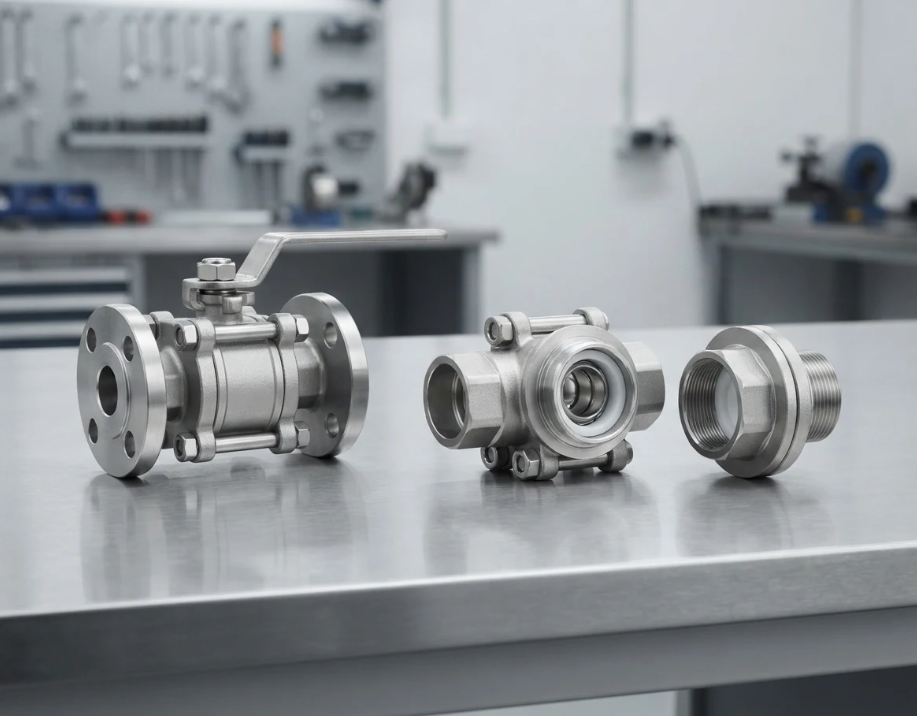
| Question | Two-piece construction | Three-piece construction |
| Basic arrangement | Main body and a separate body component | Center section between two end components |
| Access to internals | Depends on joint design and installation | May allow center removal or swing-out on suitable models |
| Need to disturb pipe connections? | Must be confirmed for the model and layout | May be reduced, but not guaranteed |
| Rating and bore | Not determined by piece count | Not determined by piece count |
| Main selection evidence | Drawing, rating and approved maintenance method | Drawing, access envelope and approved maintenance method |
This comparison describes common arrangements, not every manufacturer's product. Use the actual assembly drawing to determine how the pressure boundary is joined and what must be removed to service the valve.
On some three-piece designs, the center body can be removed or swung away while end connectors remain attached to the pipe. That can be useful where access to internal parts is part of the maintenance strategy. However, swing-out capability, clearance and the approved disassembly method must be confirmed for the exact model.
Two-piece construction may require a different removal or disassembly route. A flanged installation, a threaded assembly and a welded installation can present different access constraints even when the valve is described with the same piece count.
Measure more than face-to-face length. Consider handle or actuator access, center-body removal space, fastener access, nearby supports and any equipment that prevents movement. A maintenance feature that exists on a bench may not be usable in the installed layout.
Neither design permits casual servicing while the system is pressurized. Follow the site isolation and hazardous-energy-control procedures and the manufacturer's approved instructions. Trapped fluid and actuator energy must be addressed; loosening a body bolt is not a way to check whether the valve is safe.
Not automatically. Additional joints create sealing and assembly details that must be engineered, assembled and tested correctly, but counting joints does not predict leakage by itself. Gasket or seal design, material compatibility, fasteners, workmanship, piping loads and operating conditions all matter.
Likewise, a simpler-looking assembly is not automatically suitable for higher pressure or more severe service. Compare documented ratings and the intended application rather than using piece count as a quality ranking.
Use the valve material selection framework to review the body, seats, packing and joint seals separately. A stainless body does not prove that every supplied sealing component is compatible with the medium or cleaning process.
Both bore and support arrangement require their own review. The full port versus reduced port guide addresses passage dimensions and hydraulic trade-offs; those questions are not answered by the number of body pieces.
Similarly, floating versus trunnion support concerns how the ball is supported and how the seat system responds to pressure. Do not infer that every three-piece valve is floating, that every two-piece valve has a specific torque, or that one construction guarantees a particular isolation function.
Start with the required function and service envelope. Then compare how each offered valve would be installed, inspected and maintained in the actual piping layout. Ask the supplier to identify whether pipe connections must be disturbed, which parts can be serviced, and what space and tools the approved method requires.
Include replacement seals, parts identification, documentation and outage planning in the comparison. A more accessible construction may be valuable where repeated authorized servicing is expected, but it does not guarantee a shorter outage or lower total cost for every installation.
For welded-end designs, the installation procedure and protection of internal components must come from the manufacturer and approved project method. Do not apply a generic welding distance, cooling time or disassembly instruction across different valve models.
Use the broader ball valve selection checklist to connect body construction with pressure, temperature, fluid compatibility, operating frequency and required shutoff.
No. Its access arrangement may be useful, but the right choice depends on the service, installation, maintenance strategy and documented model limits.
No. Confirm the drawing and approved procedure. Some designs allow center-body removal rather than the same swing-out method.
Do not open or service it under pressure on the strength of its piece count. Use approved isolation, verification and manufacturer-specific maintenance procedures.
Not necessarily. Obtain the actual bore dimensions and flow data; body piece count does not define port size.
Share the medium, pressure-temperature cases, connection, installed space, required bore and maintenance expectations with KAIWEI VALVE. Request a model-specific ball valve proposal with a drawing and confirmed access method. Ask for explicit confirmation rather than assuming that a named construction or service feature is available on every product.
More News
Nov.26, 2026
Nov.25, 2026
Nov.25, 2026


