Nov.23, 2026
Choose a gate valve material by its exact grade, service compatibility and pressure-temperature rating, not by the labels cast steel and stainless steel alone. The labels are not opposites: casting is a manufacturing process, while stainless steel is an alloy family. A stainless steel gate valve can also have a cast body.
In many purchasing discussions, cast steel is shorthand for carbon cast steel such as ASTM A216 WCB, while stainless refers to a specified stainless grade such as ASTM A351 CF8M. Ask the supplier to write the actual grade before comparing two gate valve configurations.
A meaningful comparison holds the valve function and relevant construction requirements constant, then examines the proposed materials and service envelope. Comparing an unspecified carbon steel valve with an unspecified stainless valve can conceal differences in trim, seats, bolting, bonnet, testing and documentation.
Keep manufacturing route separate from chemistry. Cast versus forged is one question; carbon versus stainless is another. Neither label alone establishes pressure rating, quality level, corrosion resistance or suitability for a particular fluid.
For the broader framework, review the industrial valve material selection guide. This article narrows that framework to gate valve purchase decisions rather than ranking one material as universally better.
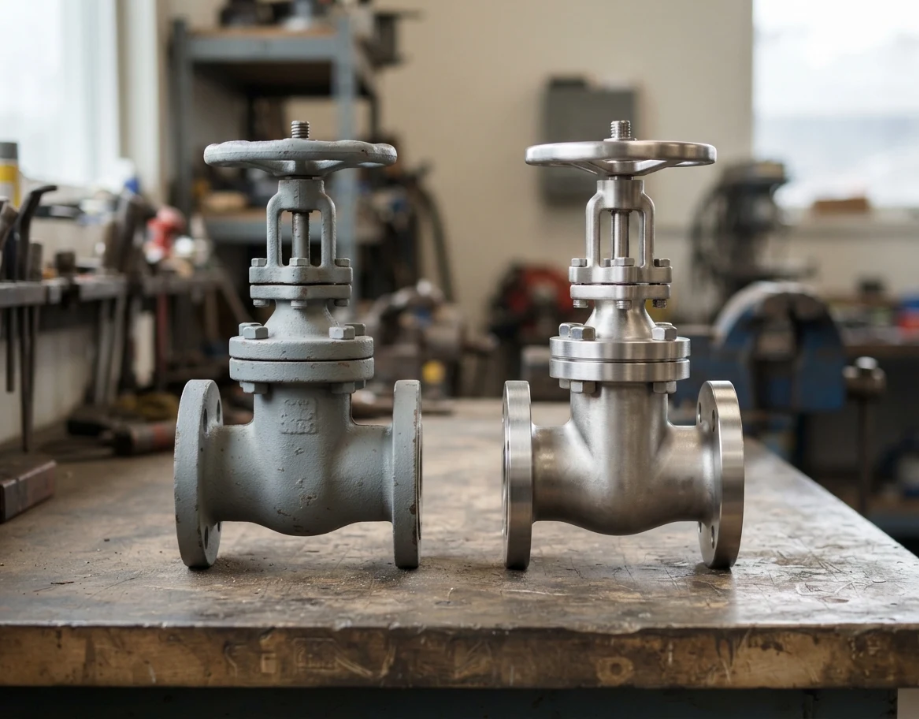
| Selection question | Carbon cast steel example | Stainless cast steel example |
| What does the name describe? | WCB is a carbon steel casting grade | CF8M is an austenitic stainless casting grade |
| Is it automatically suitable? | No; check the complete service envelope | No; check exact chemistry and exposure |
| Does class alone settle the rating? | No; use grade, temperature and construction | No; use grade, temperature and construction |
| Are body and internals identical materials? | Not necessarily; specify trim and seals | Not necessarily; specify trim and seals |
| What confirms the purchase? | Agreed grade, records and model documentation | Agreed grade, records and model documentation |
WCB and CF8M are examples for discussing grade identification. They are not a recommendation for an unreviewed application, and the table does not provide chemical compatibility approval or allowable pressure values.
Define the medium, phase, concentration, contaminants and relevant cleaning chemicals. Include solids, moisture and changes between normal operation, startup, shutdown and cleaning. An incomplete description such as water, oil or chemical service may hide the condition that controls material selection.
Carbon steel may be a candidate where its properties and corrosion behavior are acceptable for the specified conditions. Stainless steel may be considered where the exact alloy offers an appropriate response to the exposure. Neither statement makes a material suitable without review.
Stainless steel is not immune to every corrosion mechanism. Grade, temperature, concentration and local exposure matter. Do not substitute a polished appearance, a generic corrosion chart or the word marine for a documented compatibility assessment.
Two valves with the same nominal class can require different rating checks when their material groups differ. Confirm the applicable pressure-temperature data for the actual grade, size, construction and standard. Also verify any lower limits imposed by the complete assembly.
Do not select a material only because an online product range mentions a high maximum temperature. Published range endpoints do not necessarily apply to every material, size, class, packing and seat combination.
The explanation of API 600 gate valve requirements helps place design and standard references in context. A standard reference is not evidence that every offered material configuration meets every project requirement.
The body contains pressure, but the gate, seat surfaces, stem, packing and joints perform different jobs. A stainless body can still be supplied with components that need their own compatibility and temperature review. A carbon body may have different internal alloys or surface treatments, but those must be specified and documented rather than assumed.
Use the gate valve parts and working principle to build a component-by-component schedule. Include the materials of all relevant wetted parts and seals, plus the required leakage criteria and operating method.
Where deposits, solids or abrasive flow are present, review geometry, velocity and operating practice as well as material. Changing body alloy does not by itself correct seat erosion caused by unsuitable duty.
Ask each supplier to quote against the same service conditions and inspection scope. Compare the exact grade, trim, connections, operator, drawings, test records and material documentation. Identify exceptions explicitly so a lower price does not hide a different configuration.
Consider installation access, planned maintenance and the consequence of unplanned replacement without inventing a fixed service life or cost-saving percentage. A material with a higher initial price is not automatically the lowest-cost option, just as the cheaper body is not automatically economical.
Before selecting either material, confirm whether a gate valve suits the application. A material comparison cannot solve a mismatch between an isolation valve and a continuously regulating process.
Prepare the valve sizing and service data alongside the material schedule. These documents should describe the same design basis rather than developing as separate assumptions.
A stainless valve body can be cast. Stainless describes the alloy family; cast describes how the component is manufactured.
Not for every environment. Select the exact grade using the fluid chemistry, temperature and exposure conditions, with qualified technical review where needed.
Do not treat the change as automatically interchangeable. Recheck ratings, construction, connections, internals, documentation and the project specification.
No. Specify the complete relevant material schedule, service envelope, test requirements and operating arrangement.
Send KAIWEI VALVE the medium composition, temperature and pressure cases, line size, class, connection and required body and trim grades. Request a gate valve material review and ask the quotation to distinguish confirmed configuration details from assumptions or items requiring further engineering approval.
More News
Nov.26, 2026
Nov.26, 2026
Nov.25, 2026


