News
Nov.12, 2026
A globe valve is a linear-motion valve that opens, closes, or adjusts flow by moving a disc or plug toward or away from a stationary seat. Raising the disc increases the opening through the seat; lowering it reduces the opening until the disc contacts the seat. Its internal flow path makes it useful for flow adjustment, although pressure loss, shutoff, and control performance depend on the specific design and service conditions.
KAIWEI VALVE's globe valve range includes standard, Y-type, and pressure-sealed product listings. The appropriate model must be selected against the fluid, pressure, temperature, flow requirements, and project specification.
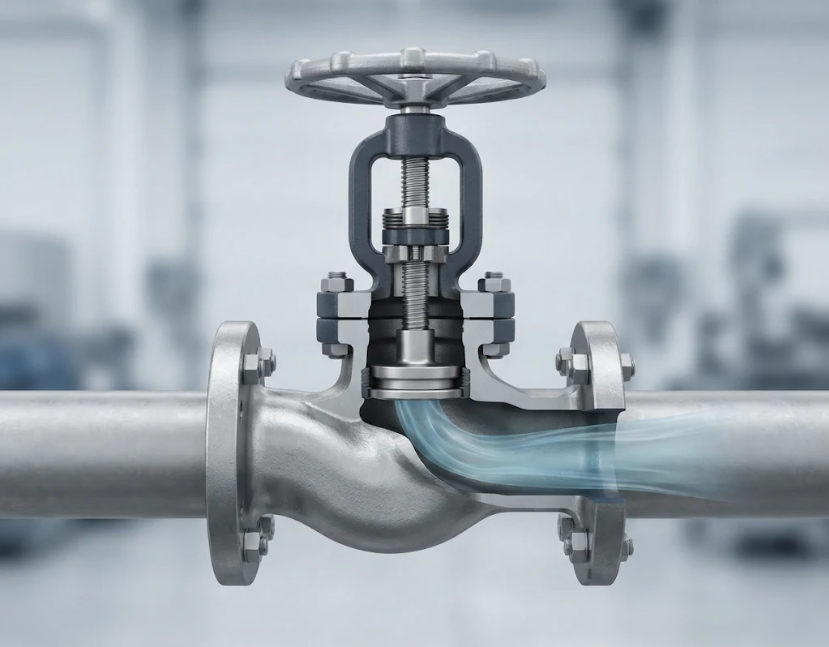
In a typical manually operated globe valve, turning the handwheel moves the threaded stem and the connected disc. As the disc lifts from the seat, fluid passes through the increasing opening. At an intermediate position, the valve restricts the passage to adjust flow. Lowering the disc onto the seat closes the valve, subject to the specified leakage acceptance and the condition of the seating surfaces.
The internal path generally changes direction as fluid travels through the body and seat opening. A change in disc position changes the available flow area, but it does not guarantee that flow changes proportionally to each handwheel turn. Actual behavior depends on trim geometry, fluid properties, valve position, and the pressure available across the valve.
For automated modulation, a globe-style control valve may combine an engineered valve body and trim with an actuator and positioner. A manual globe valve does not automatically provide the sizing data, positioning performance, or accessories required for a control loop. See the guide to which valve is best for throttling flow for the wider selection decision.
| Part | Function | What to check |
|---|---|---|
| Body | Contains the process fluid and connects the valve to piping | Material, pressure-temperature rating, body pattern, and end connection |
| Bonnet | Forms part of the pressure boundary and provides access to internal components | Joint construction, gasket, access, and design rating |
| Disc or plug | Moves relative to the seat to restrict or stop flow | Geometry, material, service compatibility, and required control duty |
| Seat | Provides the opening and a contact surface for the disc | Seat construction, material, leakage test, and repair method |
| Stem | Transmits movement and operating force to the disc | Material, travel, operating load, and protection |
| Packing | Limits leakage around the moving stem | Material, temperature, adjustment, and project emissions requirements |
| Handwheel or actuator | Supplies the motion and required operating force | Access, available utilities, thrust, stroke, speed, and fail action where relevant |
Part names and arrangements vary by design. Request the manufacturer's sectional drawing and material list for the proposed model rather than assuming all globe valves share the same trim.
Moving the disc relative to the seat lets an operator change the restriction in the flow path. This makes many globe designs candidates for manual flow adjustment or, with the correct trim and actuation, controlled modulation. The operating range still matters: high velocity, excessive noise, cavitation, flashing, erosion, or unstable control may occur if the valve is unsuitable for the pressure drop or fluid.
An oversized control valve can operate too close to its seat at normal flow, making small movements produce large changes in flow. An undersized valve may not pass the required maximum flow. Compare required capacity with the rated coefficient and travel for the selected model; our explanation of Cv in valve sizing shows why nominal pipe size alone is not enough.
Follow the flow-direction arrow, installation drawing, and manufacturer's instructions for the specific valve. Globe valve configurations may be designed for flow under or over the disc, and the permitted direction can depend on the duty, pressure, temperature, operator, and trim. Do not assume that every globe valve installs in the same direction or is bidirectional.
Check the required opening and closing differential pressures as well. Flow direction affects forces on the disc and stem; these forces must be considered when selecting a handwheel, gearbox, or actuator.
These describe body configurations, not universal pressure ratings or proof of throttling performance. Bonnet construction, including a pressure-sealed bonnet, is a separate design consideration.
A globe valve changes the opening between a disc and seat and is commonly considered for flow adjustment. A conventional gate valve raises or lowers a gate and is generally selected for fully open or fully closed isolation. A globe valve's internal flow path can create more pressure loss than a relatively straight-through gate valve, but a model-specific hydraulic comparison is needed.
For a detailed comparison of operating motion, applications, and selection criteria, see gate valve vs globe valve. Neither family name alone establishes a required shutoff leakage class.
Provide the intended function—manual adjustment, isolation, or automated modulation—and the minimum, normal, and maximum flow cases. Include fluid composition and phase, density or specific gravity, viscosity, upstream and downstream pressure, operating and design temperature, and any solids or corrosive components.
Also specify nominal size and pipe schedule, allowable pressure drop, required flow direction, materials, end connections, leakage test and acceptance criteria, cycling frequency, operator, utilities, fail action, applicable standards, and inspection documents. For control duty, request the rated Cv curve, expected travel at each case, actuator sizing basis, and assessment of noise, cavitation, or flashing where applicable.
The industrial valve sizing data checklist can help organize these details before an RFQ. Confirm the pressure-temperature rating for the actual model and material combination; a pressure class or line size alone does not complete the selection.
For an initial product review, examine the KAIWEI globe valve product listing and confirm the specific configuration against the project data sheet. Availability, ratings, materials, testing, and suitability must be verified for the quoted model.
Need a globe valve for flow adjustment or shutoff? Share your fluid, flow range, inlet and outlet pressures, temperature, line size, connection, required leakage test, and operating method with KAIWEI VALVE to discuss the available configuration and request a project-specific quotation.
A suitable globe valve can be used for flow adjustment and, when specified and tested for the duty, shutoff. The exact service depends on its construction, materials, rating, and operating conditions.
No. A manually operated globe valve and an automated globe-style control valve may use similar basic movement, but control duty requires the correct trim, sizing, actuator, and instrumentation.
Not necessarily. Follow the model's flow arrow and installation instructions, and verify the allowed pressure and operating conditions for the required direction.
The fluid passes through an internal restriction and a changing flow path. The resulting loss depends on flow, fluid properties, body and trim geometry, and valve opening.
Shutoff performance depends on the specific seat design, test conditions, valve condition, and acceptance criteria. Specify the required leakage test instead of assuming a performance level from the valve type.
More News
Nov.16, 2026
Nov.17, 2026
Nov.17, 2026


