Oct.29, 2026
A gate valve is generally used for on/off isolation with minimal flow resistance when fully open, while a globe valve is better suited to regulating flow and throttling. The main difference lies in their internal design: a gate valve lifts a gate out of the flow path, whereas a globe valve moves a disc or plug toward a seat to adjust the flow area. Choosing between them depends on flow requirements, pressure drop, operating conditions, and maintenance needs.
Gate valves: Best suited to pipeline isolation where the valve normally remains fully open or fully closed.
Globe valves: A common choice for throttling, frequent adjustment, and controlled flow regulation.
Pressure drop: A fully open gate valve typically offers lower flow resistance than a conventional globe valve.
Maintenance: The correct valve type reduces premature wear, but material, trim, operating conditions, and maintenance practices also matter.
Selection: Consider the fluid, pressure, temperature, flow rate, shutoff requirements, and applicable standards before ordering.
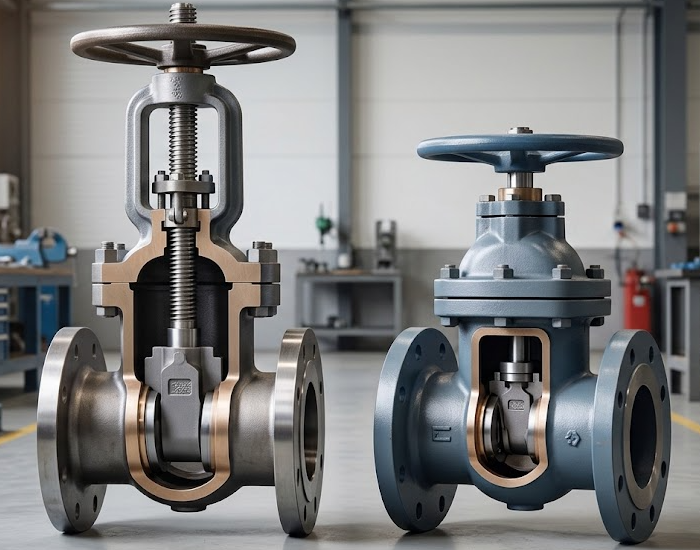
A gate valve controls flow by raising or lowering a gate, commonly a wedge-shaped disc, inside the valve body. When fully open, the gate moves clear of the main flow passage, allowing fluid to travel through a relatively unobstructed path. When closed, the gate engages the seats to isolate the pipeline.
Gate valves are commonly used in water distribution, oil and gas pipelines, petrochemical facilities, and industrial utility systems where reliable isolation is the primary requirement.
Low pressure drop when fully open: The relatively straight flow path limits resistance in many conventional designs.
Suitable for isolation: Gate valves are designed primarily for full-open and full-closed operation.
Flexible installation options: Rising-stem and non-rising-stem designs can accommodate different installation and position-indication requirements.
Broad industrial use: Available designs can be specified for a wide range of media, sizes, pressures, and temperatures.
A conventional gate valve is generally not recommended for continuous throttling. Partial opening can expose the gate and seating surfaces to high-velocity flow, vibration, and erosion. For more operating guidance, see When Should You Use a Gate Valve?
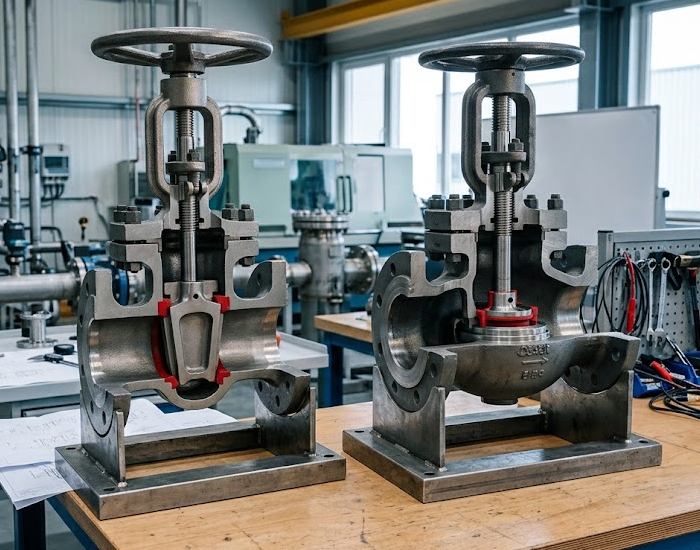
A globe valve regulates flow by moving a disc or plug toward or away from a stationary seat. As the disc changes position, it adjusts the available flow area, allowing the operator or actuator to control the amount of fluid passing through the valve.
Unlike the relatively straight flow path of a conventional gate valve, a standard globe valve usually directs fluid through a more restrictive internal passage. This creates additional flow resistance but supports controlled adjustment.
Globe valves are widely used in steam systems, boiler auxiliaries, chemical processing, cooling systems, and industrial process lines where flow regulation is important.
Effective throttling: The disc-to-seat movement allows gradual changes in the flow opening.
Suitable for frequent adjustment: Globe valves are commonly selected for services that require repeated changes in flow rate.
Flexible internal configurations: Disc, seat, and trim designs can be selected to meet different control requirements.
Combined regulation and shutoff: A suitable design can provide both flow adjustment and isolation when fully closed.
However, the suitability of a globe valve depends on its design and operating conditions. Flow capacity, pressure drop, actuator requirements, cavitation risk, and the required control range should all be assessed before selection.
Both valve types use linear motion, but they serve different operating priorities. A gate valve is primarily designed to isolate flow, whereas a globe valve is generally better suited to controlling it.
| Comparison factor | Gate Valve | Globe Valve |
|---|---|---|
| Primary function | On/off isolation | Flow regulation and isolation |
| Closing element | Gate or wedge | Disc or plug |
| Flow path | Relatively straight when fully open | More restrictive in conventional designs |
| Pressure drop | Usually lower when fully open | Usually higher |
| Throttling | Generally not recommended for conventional designs | Commonly suitable |
| Operating motion | Multi-turn linear movement | Multi-turn linear movement |
| Installation considerations | Rising-stem designs need vertical clearance | Body and piping layout must accommodate the selected design |
| Typical applications | Water mains, pipelines, isolation points | Steam lines, process control, cooling and utility systems |
These are general comparisons, not universal performance guarantees. Actual pressure loss, shutoff performance, operating torque, and service life depend on valve geometry, size, trim, materials, differential pressure, and the operating medium.
Flow control is one of the most important differences between gate and globe valves.
When a gate valve is fully open, its gate is largely removed from the flow path. This makes it useful when a pipeline needs high flow capacity and low resistance at the isolation point. However, a partially open gate does not usually provide stable, predictable throttling.
A globe valve changes the opening between the disc and seat as the stem moves. This makes it a practical option for regulating flow, but the internal flow path generally produces a greater pressure drop than a conventional fully open gate valve.
For applications where flow must be adjusted repeatedly, engineers should evaluate the required flow range, differential pressure, control stability, and potential cavitation or erosion. A purpose-designed control valve may be more suitable than either a standard gate valve or a manually operated globe valve.
A gate valve is generally the better starting point when the pipeline requires dependable isolation rather than continuous flow adjustment.
Consider a gate valve when:
The valve normally operates fully open or fully closed.
Low flow resistance at the fully open position is a priority.
The pipeline needs isolation for maintenance or shutdown.
The selected valve's pressure rating, material, and sealing design meet the service requirements.
Typical examples include water distribution mains, pipeline isolation points, and selected oil and gas or petrochemical services.
Before purchasing, confirm the pressure class, body and trim materials, end connections, operating mechanism, installation clearance, and required leakage criteria.
A globe valve is generally the stronger candidate when the process requires regular adjustment of the flow rate.
Consider a globe valve when:
Operators need to increase or decrease flow during normal operation.
The process requires controlled throttling rather than simple isolation.
The internal trim can be selected to suit the required flow characteristics.
The system can accommodate the associated pressure drop and actuator requirements.
Common examples include steam distribution, boiler auxiliary lines, chemical dosing systems, and industrial process piping.
For demanding control duties, valve selection should include flow sizing, differential pressure, operating range, cavitation and noise assessment, and actuator sizing. A standard manual globe valve should not automatically be treated as equivalent to an engineered control valve.
Before choosing between a gate valve and a globe valve, review the actual service conditions instead of relying on nominal pipe size alone.
Determine whether the valve is intended for isolation, throttling, or both. If the main requirement is on/off service, a gate valve may be suitable. If flow must be adjusted regularly, a globe valve or a purpose-designed control valve is usually a better starting point.
Confirm the maximum and minimum operating conditions, design pressure, temperature range, fluid composition, viscosity, and any corrosive or abrasive characteristics. These factors affect body material, trim, seat selection, packing, and the required pressure-temperature rating.
Compare the required flow rate and allowable pressure drop. A gate valve may be advantageous for low-resistance isolation when fully open, while a globe valve can provide the variable opening required for regulation. Final sizing should be based on actual process data.
Confirm the applicable design standard, pressure class, face-to-face dimensions, end connections, inspection requirements, and pressure testing standard. Relevant requirements may include ASME B16.34, API 598, or other standards specified by the project and valve design.
The purchase price is only one part of valve cost. Consider installation space, operating frequency, actuator needs, maintenance access, replacement parts, energy losses, and the consequences of an unsuitable valve choice.
For a broader selection framework, see How Do You Choose the Right Industrial Valve?
Neither valve is universally better. The right choice depends on the job the valve must perform.
Choose a gate valve when the priority is on/off isolation and a relatively unobstructed flow path when fully open. Choose a globe valve when controlled flow regulation is more important than minimizing pressure loss. If the application requires rapid operation, compact installation, or specialized control performance, other valve designs may also deserve consideration.
At KAIWEI VALVE, industrial valve selection starts with the application and operating conditions. Our product range includes gate valves, globe valves, ball valves, butterfly valves, and other industrial valve solutions. Review our industrial valve products or explore our globe valve range to identify suitable options for your project.
For a more accurate recommendation, provide the medium, nominal size, operating and design pressure, temperature range, required flow rate, end connection, material requirements, and applicable standards when requesting a quotation.
A gate valve is primarily designed for on/off isolation, while a globe valve is generally better suited to throttling and flow regulation.
A conventional gate valve typically has lower pressure drop when fully open because its flow path is relatively straight. Actual performance depends on the valve's bore, geometry, size, and flow conditions.
Conventional gate valves are generally not recommended for continuous throttling because partial opening can cause unstable flow, vibration, erosion, and seat damage. Follow the manufacturer's instructions for the specific design.
Some globe valve designs are available for high-pressure services. Suitability depends on the pressure-temperature rating, body and trim materials, construction, and applicable design requirements—not simply the valve type.
Both can shut off flow when properly selected and operated. Gate valves are primarily used for isolation, whereas globe valves are commonly chosen when flow regulation and shutoff are both required.
Start with the required function, then evaluate pressure drop, flow rate, medium, temperature, pressure rating, materials, operating frequency, maintenance access, and applicable standards. Confirm the final selection against the actual service conditions and product datasheet.
More News

Oct.09, 2026


