News
Sep.23, 2026
Choose an industrial valve by defining its function, then documenting the fluid, flow cases, inlet and outlet pressure, temperature, allowable pressure drop, shutoff requirement, materials, pipe interface, actuation, standards, testing, and maintenance constraints. The correct choice is a verified configuration, not simply a valve-family name or nominal pipe size.

The first selection question is what the valve must do. A valve intended to remain fully open or closed has a different duty from a control valve that must hold intermediate travel. A check valve responds to forward and reverse flow rather than an operator. A three-way valve may divert or mix streams. Emergency shutdown adds stroke-time, fail-action, energy-source, and proof-test requirements.
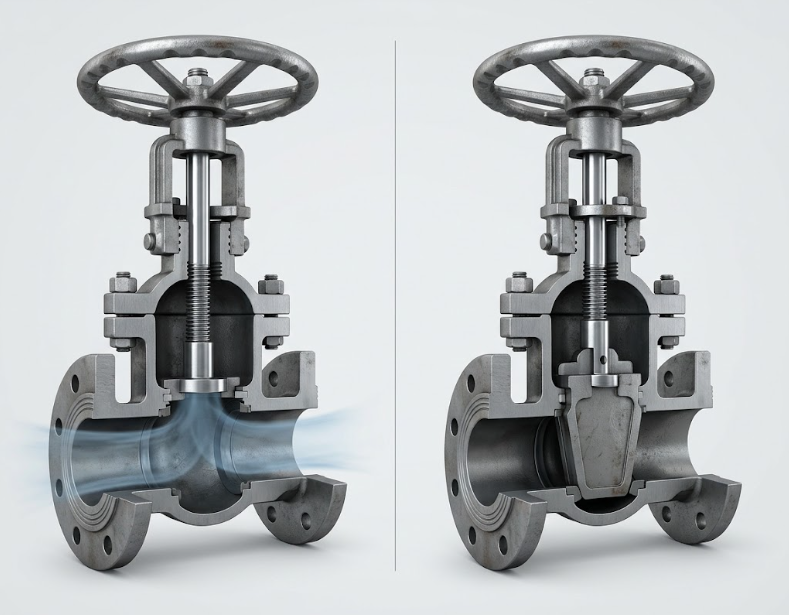
Do not assume one family is always best. Ball and gate valves are common isolation candidates; control valves may be evaluated for modulation; butterfly valves may offer a compact option; check valves prevent reverse flow. Each candidate still needs model-specific evidence.
List every process and cleaning fluid, including composition, concentration, phase, solids, viscosity, corrosiveness, toxicity, and whether the medium can crystallize, polymerize, flash, or cavitate. Record minimum, normal, maximum, and design temperature rather than one typical value.
Pressure data must include upstream and downstream conditions for every flow case, plus design pressure and whether readings are gauge or absolute. The required pressure class cannot be selected from pressure alone because material and temperature determine the applicable pressure-temperature rating.
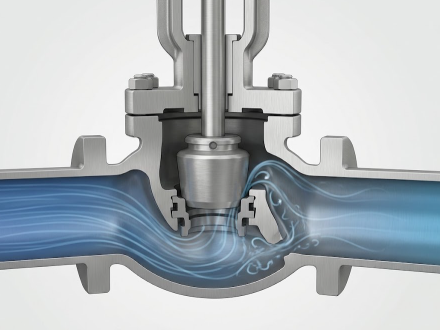
Nominal pipe size defines the connection, not necessarily the required control-valve body or trim. The guide to the information needed to size an industrial valve explains which process and piping data should be collected before calculation. For isolation service, check port or bore, velocity, pressure loss, pigging, and line-cleaning requirements. For modulation, calculate required Cv or Kv for each operating case and evaluate travel, rangeability, pressure recovery, noise, cavitation, flashing, and stability. The comparison of valves for throttling flow provides a useful starting point before model-specific sizing.
The Fisher Control Valve Handbook treats liquid and compressible-flow sizing, installed behavior, actuator response, materials, pressure-temperature ratings, cavitation, flashing, and noise as connected subjects. A preliminary capacity calculation is therefore not a final valve selection.
Specify the body, bonnet, closure element, stem or shaft, seat, packing, gasket, and other wetted or pressure-containing materials. The body material alone does not define the complete valve. Soft seats, engineered polymers, elastomers, coatings, hardfacing, and metal seats have different limits and failure modes.
Chemical-compatibility tables can support screening, but the selected compound, concentration, temperature, pressure, cycling, decompression, solids, and cleaning regime still require review. Ask for the exact material designation and model-specific pressure-temperature data.
Record nominal size, schedule or bore, flange facing, pressure class, butt-weld preparation, face-to-face dimension, allowable loads, installation orientation, and available envelope. A valve that fits the nominal size can still be incompatible with the flange, bore, piping stress, actuator clearance, or maintenance access.
The Swagelok valve-selection guide groups size, temperature, application, media, pressure, ends, and delivery as connected selection inputs. For project valves, expand that framework to include shutoff, standards, testing, actuation, and documentation.
State manual, gearbox, pneumatic, electric, hydraulic, or self-operated requirements. Powered packages need available air pressure or voltage, control signal, hazardous-area classification, fail-open/fail-closed/fail-in-place action, stroke time, position feedback, manual override, and environmental enclosure.
Actuator sizing requires the selected valve’s force or torque across the operating envelope. Do not size the actuator from nominal valve size alone or assume that an actuator shown on one catalog model fits another configuration.
ASME B16.34 covers subjects including pressure-temperature ratings, materials, dimensions, examination, testing, tolerances, and marking for specified new valve construction. Product-specific standards, piping codes, end-connection standards, leakage tests, fire tests, fugitive-emissions requirements, and project specifications may add separate obligations.
The request for quotation should identify the required edition and document package: data sheet, drawing, bill of materials, pressure test records, material certificates, inspection plan, NDE, coating, preservation, and data book. A supplier should state exceptions rather than silently substituting a different basis.
| Decision area | Information to provide | Supplier response to request |
|---|---|---|
| Duty | Function, normal position, cycling, fail action | Selected family and model |
| Process | Fluid, flow cases, pressures, temperatures | Sizing basis and limits |
| Mechanical | Size, class, materials, ends, face-to-face | Drawing and bill of materials |
| Performance | Pressure drop, shutoff, noise, surge concerns | Calculations and test basis |
| Quality | Standards, inspection, certificates, data book | Compliance statement and exceptions |
Use KAIWEI’s product directory to identify a starting family and the solutions page to frame demanding pressure, diameter, temperature, or corrosive-media requirements. Send the completed service sheet through the contact page and request a model-specific technical response.
More News
Oct.01, 2026

Sep.30, 2026
Sep.25, 2026


